
Every free museum window, park, plaza and permanently free site in Madrid, sorted by what it actually costs you — money, a booking, or the right day.
Madrid is one of the cheaper major European capitals to look at. Nearly every big museum has a free window, the parks are all free, and the entire historic centre is a walkable outdoor exhibit. The catch is that “free” covers three different things, and confusing them is how people end up standing outside a locked door.
This guide sorts everything by what it actually asks of you: nothing at all, a free ticket booked in advance, or turning up on the right day at the right hour. The times below are checked against the individual attraction pages on this site — a wrong free-entry time costs you an evening, so treat the exact figures as the point.
Free with no ticket, no timing, no planning
These cost nothing and ask nothing. They are the backbone of a cheap trip.
The parks. El Retiro is open 06:00 to midnight from April to September and until 23:00 the rest of the year — the rowing boats cost money, everything else doesn’t. Madrid Río runs along the reclaimed Manzanares 24/7, with summer fountains and a path that reaches all the way to Matadero Madrid, a former slaughterhouse turned arts complex whose grounds and most exhibitions are free year-round. Casa de Campo is open around the clock and free to enter, though the zoo and the cable car are not.
The royal gardens. Sabatini Gardens sit against the north facade of the Royal Palace, open 09:00–22:00 May to September and 09:00–21:00 October to April, and are at their best in the last hour of light. Campo del Moro, the English-style gardens behind the palace, is free too but keeps shorter hours — 10:00–20:00 in summer, 10:00–18:00 in winter — and occasionally closes for official events.
The plazas. Plaza Mayor, Puerta del Sol, Plaza de Oriente, Plaza de la Villa with its surviving medieval fabric, Plaza de Santa Ana and the rebuilt Plaza de España are all open permanently and cost nothing until you sit down at a terrace, at which point they cost a great deal.
The architecture you only need to look at. The Metropolis Building at the corner of Gran Vía and Calle de Alcalá is a private office building with no public interior — which is fine, because the winged statue and gilded dome are the whole point, and they are best in the ten minutes when the last daylight hits the dome and the building lights come on. Walking Gran Vía end to end takes 45 to 90 minutes and is free. So is Plaza de Cibeles and the Puerta de Alcalá. The vertical garden at CaixaForum — roughly 15,000 plants across four storeys — is visible from the pavement at any hour, and most people who photograph it never buy a ticket.
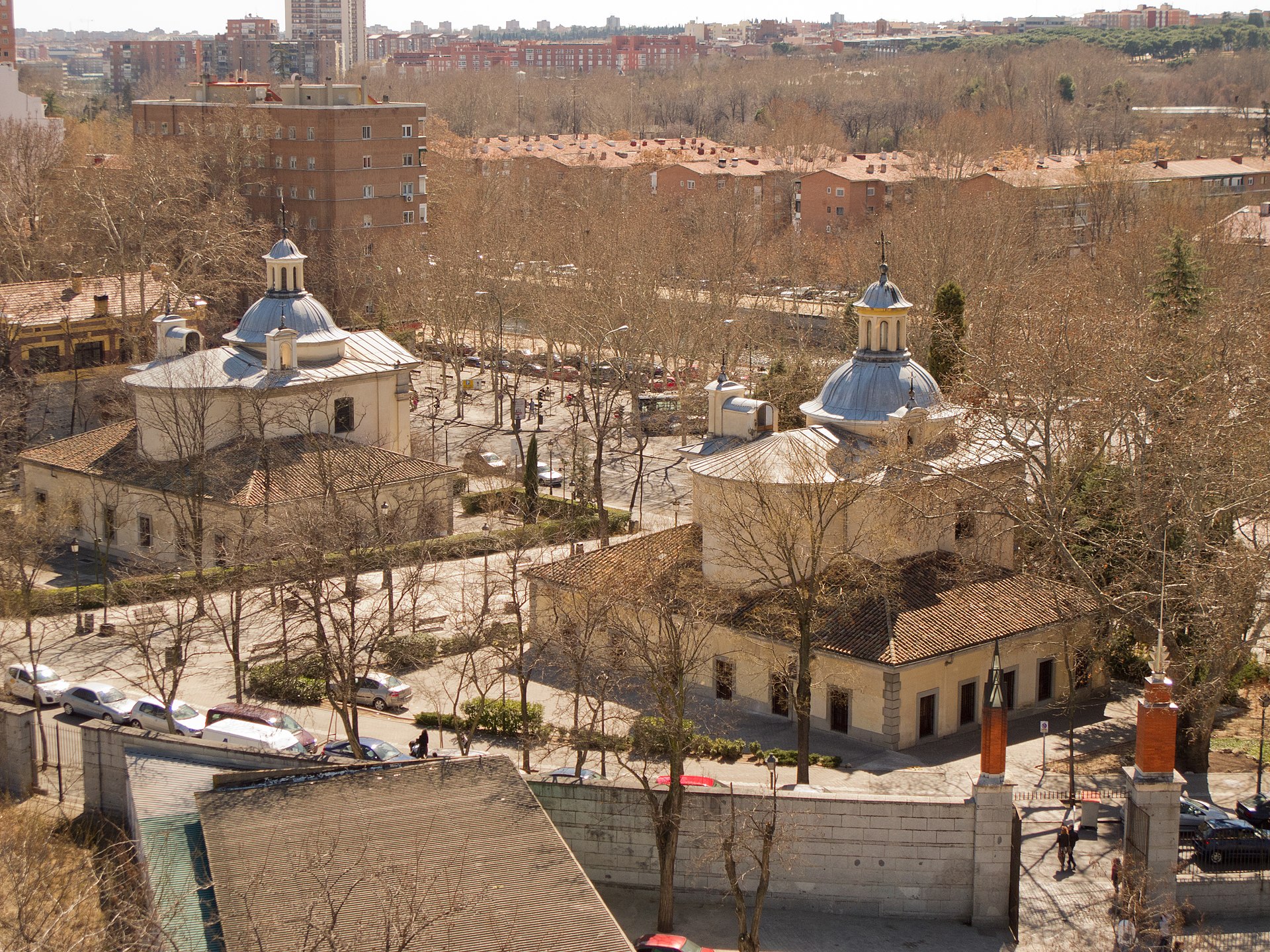
Two interiors that never charge. The Ermita de San Antonio de la Florida holds a complete 1798 Goya fresco cycle on its dome, with Goya buried in the floor beneath it, and it is free every open day, all hours — Tuesday to Sunday 09:30–20:00, closed Mondays. It is the single best free thing in Madrid and almost nobody schedules it. And the nave of Almudena Cathedral is free to enter (donations welcomed); only the crypt, museum and dome viewpoint charge, at roughly €6–7.
El Rastro, Sunday mornings. Madrid’s flea market runs Sundays and public holidays, 09:00–15:00, down Ribera de Curtidores. It is free to browse, it is not open any other day of the week, and going at 09:00 gets you the best stalls before the crowd — and the pickpocket risk — peaks. Roll straight into La Latina afterwards for the tapeo, which is not free but is cheap.
Free, but you need to reserve a ticket
The Temple of Debod. This is the one that catches people out. The grounds — the reflecting pool, the terraces, the sunset view west over Casa de Campo — are free and always open. The interior of the temple, with its reliefs, requires a free timed-entry ticket reserved online in advance via madrid.es, and it opens Tuesday to Sunday, 10:00–20:00 in winter and 10:00–19:00 in summer, closed Mondays. If you only came for the sunset, ignore all of that and arrive 30 to 45 minutes early to claim a spot on the terraces.
The Prado’s free evening slot is also technically a reservation (see below).
Free only on the right day and hour
This is where precision matters. Museum free windows in Madrid are not a single pattern — they differ per institution, and several are narrower than travellers assume.
- Museo del Prado: free every day in the two hours before closing — Monday to Saturday 18:00–20:00, Sunday and holidays 17:00–19:00. Requires a free timed slot booked online, released roughly two to three weeks ahead. Walking up without one usually fails.
- Reina Sofía: free Saturdays 14:30–21:00 and Sundays 10:00–14:30. Closed Tuesdays. Sunday morning draws the week’s longest queue — arrive by 09:45.
- Thyssen-Bornemisza: free Mondays 12:00–16:00, permanent collection only, tickets at the door with no online booking. Quietest of the three free windows, because it lands on the day the other two are closed or on restricted hours.
- Sorolla Museum: free Saturdays 14:00–20:00 and all day Sunday, 10:00–15:00. Otherwise €3.
- Museo Cerralbo: free Thursdays 17:00–20:00 and all day Sunday, 10:00–15:00. Take the Thursday evening — the mirrored ballroom needs the period lighting.
- Museum of Romanticism: free all day Sunday and Saturdays from 14:00.
- National Archaeological Museum: free Saturdays from 14:00 and Sunday mornings (it closes at 15:00 on Sundays).
- Museo Lázaro Galdiano: free Tuesday to Friday, 14:00–15:00 only. That is one hour, on weekdays, at the end of the morning session — it is not a daily window, and there is no free entry at weekends, when the museum runs mornings only (09:30–15:00). Otherwise €8, or €5 reduced.
- Royal Botanical Garden: free Tuesdays 10:00–13:00. Otherwise €4.
- Basílica de San Francisco el Grande: the museum area is free on Thursdays, within its narrow visiting hours.
- Royal Palace of Madrid: free for EU and Ibero-American citizens Monday to Thursday in the last two hours before closing (roughly 16:00–18:00 in winter, 17:00–19:00 in summer). Passport-dependent, so not free for everyone.
- Descalzas Reales: free for EU and Ibero-American citizens Wednesday and Thursday 16:00–18:30, with proof of residency. Guided-tour-only, usually in Spanish.
Four dates make almost all of the state museums free for everybody: April 18, May 18, October 12 and December 6.
A free week, day by day
If you are here for several days, the free windows fall into a natural order.
Monday. The Prado and most state museums are shut or awkward; the Thyssen’s free 12:00–16:00 window is the day’s best move. Fill the rest with the plazas and Sabatini Gardens.
Tuesday. Botanical Garden free 10:00–13:00, Lázaro Galdiano free 14:00–15:00 if you are prepared to cross town for one hour of Bosch and Goya. Debod interior reopens after Monday closure.
Wednesday. Thin on free museums — this is the day for the Ermita de San Antonio de la Florida, Madrid Río and a long walk through Barrio de las Letras, plus the Prado’s 18:00–20:00 slot if you booked it.
Thursday. The strongest evening of the week: Cerralbo 17:00–20:00, San Francisco el Grande’s museum, and the Royal Palace’s late window if you hold an EU or Ibero-American passport.
Friday. Lázaro Galdiano’s 14:00–15:00 hour again, then the Prado at 18:00.
Saturday afternoon. The best free block of the whole week. Reina Sofía 14:30–21:00, Sorolla from 14:00, the Archaeological Museum from 14:00, the Museum of Romanticism from 14:00. Pick two, not four.
Sunday. El Rastro at 09:00, then Cerralbo, Sorolla, Romanticism or the Archaeological Museum — all free, all closing at 15:00 — and the Reina Sofía until 14:30. Parque El Capricho also opens, since it runs weekends and public holidays only, free, with a 1,000-visitor cap that argues for arriving at the 09:00 opening.
Things that look free and aren’t, or aren’t what you’d expect
- The Palacio de Cristal is closed inside for structural restoration until roughly 2027. The glass pavilion and its pond are still there, still free, and still the best photograph in El Retiro — you just cannot go in.
- Mercado de San Miguel costs nothing to walk into and is priced for tourists once you order: €3–6 a tapa, €15–30 for a graze. Worth seeing the iron-and-glass hall; eat elsewhere.
- Rooftop views are not free. The Círculo de Bellas Artes terrace runs about €5–5.50, and the Mirador Madrid at Palacio de Cibeles charges too. The genuinely free alternative is the western terraces at Debod at sunset.
- Parque El Capricho is weekends and holidays only — turning up on a Wednesday means a locked gate after a 20-minute walk from the metro.
For planning which museums are worth paying for when the free windows don’t fit your trip, see the best museums in Madrid guide, and for getting between all of this cheaply, getting around Madrid.


Where to Stay Near Free Things to Do in Madrid
Real current prices via Agoda. Dates shown are indicative — pick your own on the next step.
Related Guides


Covered in this guide
 free
freeTemple of Debod
A genuine 2nd-century BC Egyptian temple, gifted to Spain and rebuilt stone by stone in a Madrid park — famous above all for its sunset views.
freeErmita de San Antonio de la Florida
A small neoclassical chapel with a ceiling fully frescoed by Francisco Goya in 1798, who is also buried here — free to visit and largely overlooked by tourists.
must seeEl Retiro Park (Parque del Buen Retiro)
A 350-acre royal park with a rowing lake, a rose garden, and shaded avenues where Madrid comes to walk, picnic, and breathe.
freeSabatini Gardens (Jardines de Sabatini)
Neoclassical, symmetrical gardens on the Royal Palace's north side, built where the royal stables once stood, with the best framed view of the palace facade.

Campo del Moro
English-style romantic gardens behind the Royal Palace, named for a 12th-century Moorish siege camp, with fountains and the palace's most dramatic facade view.

Madrid Río Park
A 10-kilometer green corridor along the Manzanares River, built over a buried highway, with 33 bridges, an urban beach, and Madrid's best bike path.