

A 1.3-kilometer avenue of early-20th-century towers, historic theaters, and flagship shops that's been Madrid's liveliest street since it opened in 1910.
Walk it in one direction, and start at the Alcalá end
Gran Vía is 1.3 kilometres long and it is not a place you visit — it is a walk you take. Nothing about it makes sense as a single stop, because the avenue was built in three separate phases between 1910 and 1929 and each phase looks different from the last. Stand still anywhere on it and you see one architectural mood; walk the whole thing and you watch Belle Époque turn into Art Deco turn into stripped-back Rationalism over about an hour.
Walk it southeast to northwest — from Calle de Alcalá up to Plaza de España. That direction runs the architecture in chronological order, and it ends at a natural stopping point rather than dumping you back into the crush at Puerta del Sol. Budget 45 to 90 minutes at a browsing pace with stops for photographs. Three metro stations sit directly on the route — Gran Vía (Lines 1, 5), Callao (Lines 3, 5) and Plaza de España (Lines 3, 10) — so you can bail out or join at any point.
The avenue exists because Madrid demolished a warren of narrow medieval lanes to build it, a scheme royal planners had wanted for decades before ground broke in 1910.
Section one: Alcalá to the Telefónica tower
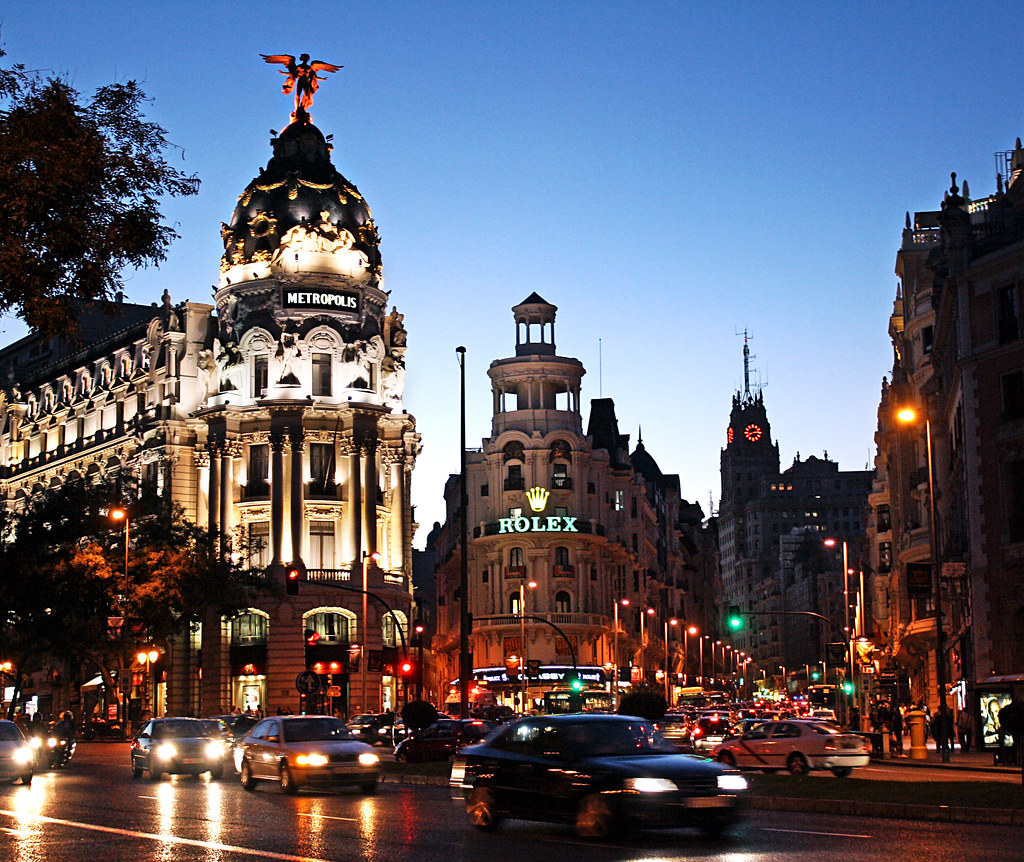
The first stretch is the ornate one, French-influenced Belle Époque, and it opens with the avenue’s most photographed corner. The Edificio Metrópolis (1911) sits at the junction with Calle de Alcalá, capped by a dome and a winged statue — technically it addresses Alcalá rather than Gran Vía itself, but nobody makes that distinction on foot, and the Metrópolis Building is where most people start taking pictures. Look for the Edificio Grassy just past it near Gran Vía 1, a smaller Art Deco jewellery-store building with an elegant rounded corner and clock that almost everyone walks past while looking at its larger neighbours.
This first section is also the one to detour off. Círculo de Bellas Artes is a few steps down Calle de Alcalá, and its rooftop terrace gives the best elevated view of the whole avenue for a small fee — worth doing at the start so you can see where you are about to walk.
The Edificio Telefónica (1929) closes this stretch: once the tallest building in Spain, and one of the few in Europe built to an American skyscraper template. It also made the avenue a target. International journalists covering the Spanish Civil War nicknamed Gran Vía “Howitzer Alley” for the shelling it took, with the Telefónica tower used as an artillery ranging mark while residents carried on watching films in the cinemas below.
Section two: the theatre run into Callao
Past Telefónica the avenue shifts. This middle stretch holds Spain’s densest concentration of theatres, which is where the Broadway and West End comparisons come from — musical and drama houses running major Spanish-language productions year round. Walk-up tickets for the popular musicals sell out, particularly on weekends, so book online if a show is part of the plan rather than hoping to improvise.
It is also the busiest, loudest and most commercial section, with the flagship stores from Zara to Primark clustered here, and it ends at Plaza del Callao — the point where foot traffic is heaviest and where the avenue’s curve becomes visible. Turn around and look back east from Callao: that curve lines up the Edificio Metrópolis in the distance and gives you the single best composition on the street, far better than any straight-on shot.
Pickpocketing is a genuine concern along this stretch, concentrated around the Callao metro entrances and the department store doors, for the ordinary reason that this is where the density of distracted shoppers peaks. Keep bags closed and in front.
Section three: Callao to Plaza de España
The last stretch is the sleekest — Art Deco and Rationalist, less decorated, taller and blockier. The Edificio Carrión, better known as the Capitol Building, anchors the Callao end of it: a curved Art Deco landmark with a historic cinema inside and the neon signage that appears in every night-time photograph of Madrid ever taken.
From here the avenue runs straight to Plaza de España, which is the natural end of the walk and hands you onward options — the Temple of Debod is a short climb west and is where most people go for sunset. Step one block north instead and you are in Malasaña, which is where the avenue’s shopping crowd thins into something considerably more interesting.
Coming back after dark, and going up
Do the walk twice if you have the time, because the avenue is a different street at night. Roughly 30 to 45 minutes after sunset, the theatre marquees, neon and building uplighting all switch on and Gran Vía turns into something closer to a stage set. Evening is the honest answer to when to visit.
Several buildings along the route — a number of them former bank and insurance headquarters — now have rooftop terraces, and these are among the better sunset-drink spots in the city. They are best May through September; in the coldest months many close or pull in their outdoor seating, so check ahead if the rooftop is the point rather than a bonus. Reserve on weekend evenings.
Practicalities the length of the walk creates
The single most underrated problem with Gran Vía is that there is essentially no tree cover. In July and August it is one of the hottest, most sun-exposed walks in central Madrid — stick to the shaded side of the street, or shift the walk to early morning or evening, which is what our guide to Madrid’s weather and best time to visit recommends for any long stretch of open pavement here. Shoes matter more than the flatness suggests; this is a long, relentlessly paved kilometre and a bit.
Access is straightforward: wide, flat, step-free pavements throughout, with elevator access at all three metro stations on the route. The width and constant visual interest make it workable with children, though the noise and crowd density are real.
Eating on Gran Vía itself is the avoidable mistake. The restaurants facing the avenue are chains at tourist prices; turn one block off onto a side street like Calle de la Reina for a proper sit-down menú del día at a fraction of it. Walking the avenue and window-shopping costs nothing, which makes a single rooftop drink the sensible place to put the budget.


Where to Stay Near Gran Vía
Real current prices via Agoda. Dates shown are indicative — pick your own on the next step.
Gran Vía: Quick Answers
What are the opening hours of Gran Vía?
Open 24 hours, always accessible
How much does it cost to visit Gran Vía?
Free to walk; prices vary for shops, theaters, and rooftop bars along it
How do you get to Gran Vía?
Gran Vía (Lines 1, 5), Callao (Lines 3, 5), or Plaza de España (Lines 3, 10) — all sit directly on the avenue. Starts a 2-minute walk north of Puerta del Sol
How long should you plan to spend at Gran Vía?
45-90 minutes to walk the full length at a browsing pace
Is Gran Vía good for kids?
Wide sidewalks and constant activity make it an easy, engaging walk with kids, though it's also one of the busiest and noisiest streets in the city
Is Gran Vía wheelchair accessible?
Flat, wide, step-free sidewalks throughout, with elevator access at metro stations along the route
Any tips for visiting on a budget?
Walking the avenue costs nothing — window-shop the flagship stores, admire the architecture, and save spending for a single rooftop drink rather than a full meal at the pricier chains
Where to Go Next
 must see
Puerta del Sol
Madrid's busiest square marks Spain's Kilometer Zero and the symbolic heart of the city, home to the Bear and Strawberry Tree statue and the New Year's Eve clock.
 must see
Plaza de España
A historic square reopened in 2021 after a major pedestrian-friendly renovation, still centered on its grand monument to Miguel de Cervantes, Don Quixote, and Sancho Panza.

Círculo de Bellas Artes
A century-old arts society whose rooftop terrace delivers arguably the best 360-degree panoramic view of Madrid's skyline for the price of a coffee.