

Madrid's grandest 17th-century square, ringed by porticoed apartments and cafe terraces, has hosted royal weddings, bullfights, and the Inquisition.
A square designed to be watched from above
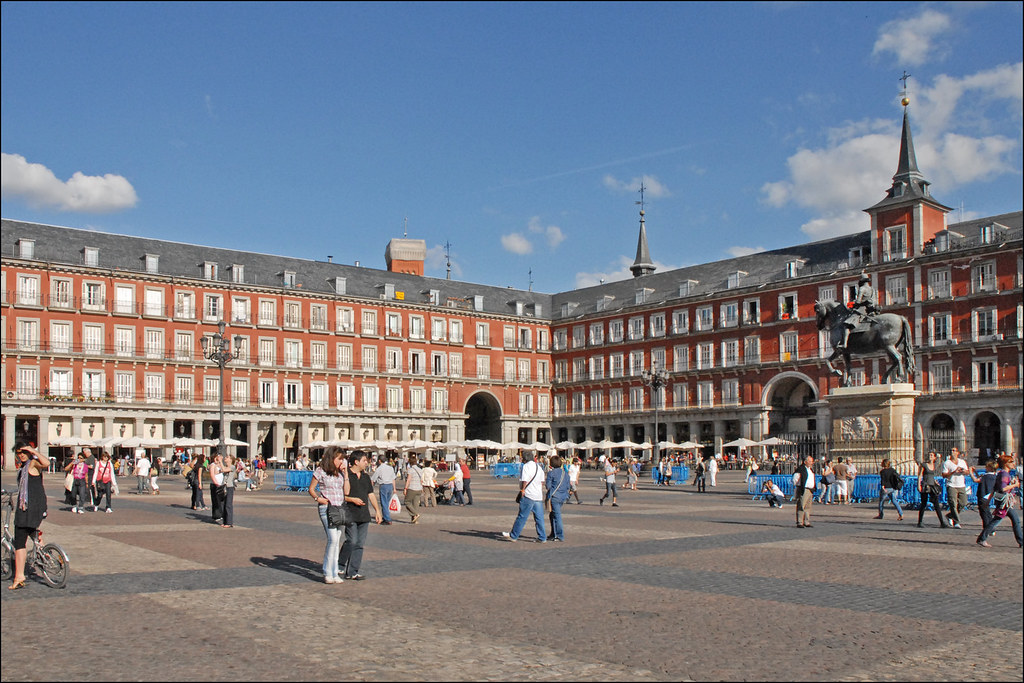
Plaza Mayor is Madrid’s formal front room: a rectangle of 129 by 94 metres, closed on all four sides by uniform nine-storey buildings with slate spires, wrought-iron balconies and 237 windows looking down on the cobblestones. Almost every visitor to Madrid crosses it, and the reason is legible the moment you step through one of the arches — nowhere else in the city delivers Habsburg-era ambition in a single frame.
The proportions are the whole point. This was never a square to stand in the middle of; it was built so that the people who mattered could watch from the balconies while everyone else filled the floor. The building numbers on the facades are still the original 17th-century ones, so when you look up you are seeing exactly where Madrid’s nobility rented seats to watch what happened below.
Twenty to forty minutes covers a proper look, longer if you sit down for a coffee. It is unapologetically touristy — street performers dressed as Velázquez, overpriced sangria — but it earns the crowds. It works for almost everyone: history is packed into the address, the space is open and car-free so children can run without dodging traffic, and it is one of the most symmetrical set pieces in Europe for photographers.
Bullfights, autos de fe and three fires
Philip II ordered the square built on the site of the Plaza del Arrabal, Madrid’s medieval marketplace, and his son Philip III saw it finished in 1619 under the architect Juan Gómez de Mora. The equestrian statue of Philip III now standing at the centre arrived much later, in 1848; it had originally stood in the Casa de Campo, a gift from the Grand Duke of Tuscany.
For two centuries this was the crown’s stage for anything the public was meant to witness: royal weddings, the coronation festivities of Charles II, bullfights with the balconies rented out as box seats, and the autos de fe of the Spanish Inquisition, at which the accused were sentenced and sometimes burned in front of the crowd. Near the Arco de Cuchilleros a small, easily missed plaque marks where the old execution site stood — a quiet counterweight to the present-day festival atmosphere.
The square burned three times, most seriously in 1790, and was rebuilt by Juan de Villanueva, the architect behind the Museo del Prado. That rebuild gave it the restrained uniformity it has today. The Casa de la Panadería on the north side was once the royal bakery and now houses Madrid’s tourism offices; its frescoed facade, repainted in 1992 by the artist Carlos Franco with zodiac and mythological figures, is the square’s single most photographed detail — step well back to take in the whole mural.
What to look at, and where not to eat
Beyond the Casa de la Panadería and the Philip III bronze, which doubles as the square’s default meeting point, the nine entrance arches each have a name and reward a glance. Arco de Cuchilleros on the southwest corner is the one to seek out: a steep stairway dropping into the old knife-makers’ quarter, and, incidentally, the door to Sobrino de Botín at its foot.
Two recurring markets are worth timing a visit around. A low-key stamp and coin market has run in the square on Sunday mornings for decades, and from early December through New Year the Christmas market fills it with wooden stalls selling decorations, costumes and roasted chestnuts. The square is at its liveliest during that market and again for the San Isidro festival in May.
The one firm piece of advice: do not eat a full meal at the plaza-facing restaurants. They charge tourist prices for forgettable food. Use the square for the view, then walk two minutes to Mercado de San Miguel for vermouth and jamón at the counter, or grab a bocadillo de calamares from a bar on Calle de Toledo for a few euros.
Practicalities are simple, since entry is free and the square never closes. The paving inside is smooth and even, but the streets around it and into La Latina are cobbled and better suited to flat, sturdy shoes. Wheelchair users should enter from Calle Mayor or Calle de Toledo rather than the stepped Arco de Cuchilleros side. In July and August the open stone has zero shade and feels like a frying pan by 2 PM; in December and January wind funnels through the entrance arches, so carry a layer even on a mild day. Pickpockets work this square precisely because it is crowded and everyone is looking up — keep bags zipped and in front of you.
For photographs, stand under the Arco de Cuchilleros and frame the square through the archway with the Casa de la Panadería centred in the distance. Late-afternoon light hits its frescoed facade directly, around 7–8 PM in summer and 5–6 PM in winter. Before 9 AM is the only realistic window for an empty square; crowds build through the morning and peak from late morning to evening, hardest at weekends and in high season, when the arcade lights and street performers after 9 PM are their own reason to come back.
Three minutes in any direction
Puerta del Sol is a three-minute walk east, worth the detour for Kilometre Zero and the Bear and Strawberry Tree statue. Mercado de San Miguel, just around the corner, is a glass-walled 1916 iron market turned upscale tapas hall and the obvious place to actually eat. For an architectural counterpoint, Plaza de la Villa — Madrid’s old medieval town-hall square — sits a few minutes west and shows a city that predates Plaza Mayor entirely.


Where to Stay Near Plaza Mayor
Real current prices via Agoda. Dates shown are indicative — pick your own on the next step.
Plaza Mayor: Quick Answers
What are the opening hours of Plaza Mayor?
Open 24 hours, always accessible
How much does it cost to visit Plaza Mayor?
Free to enter
How do you get to Plaza Mayor?
Sol (Lines 1, 2, 3) or Tirso de Molina (Line 1), both about a 5-minute walk. 3-minute walk from Puerta del Sol
How long should you plan to spend at Plaza Mayor?
20-40 minutes, longer if you sit down for a coffee
Is Plaza Mayor good for kids?
Wide open, traffic-free, and full of street performers and portrait artists — an easy stop with kids, though the surrounding tourist-menu restaurants are mediocre and overpriced
Is Plaza Mayor wheelchair accessible?
Flat and step-free once inside, but reached via sloped or stepped entrances from several sides; the Arco de Cuchilleros side has stairs, so wheelchair users should enter from Calle Mayor or Calle de Toledo
Any tips for visiting on a budget?
It costs nothing to visit — skip the pricey terrace cafes ringing the square and grab a bocadillo de calamares from a nearby Calle de Toledo bar instead
Where to Go Next
 must see
Puerta del Sol
Madrid's busiest square marks Spain's Kilometer Zero and the symbolic heart of the city, home to the Bear and Strawberry Tree statue and the New Year's Eve clock.
 must see
Mercado de San Miguel
A 1916 cast-iron produce market reborn as Madrid's most glamorous gourmet tapas hall, where oysters, vermouth, and jamón ibérico change hands under a century-old glass roof.

Plaza de la Villa
One of Madrid's best-preserved medieval squares, ringed by 15th- to 17th-century buildings just steps from Plaza Mayor, and often overlooked entirely.