
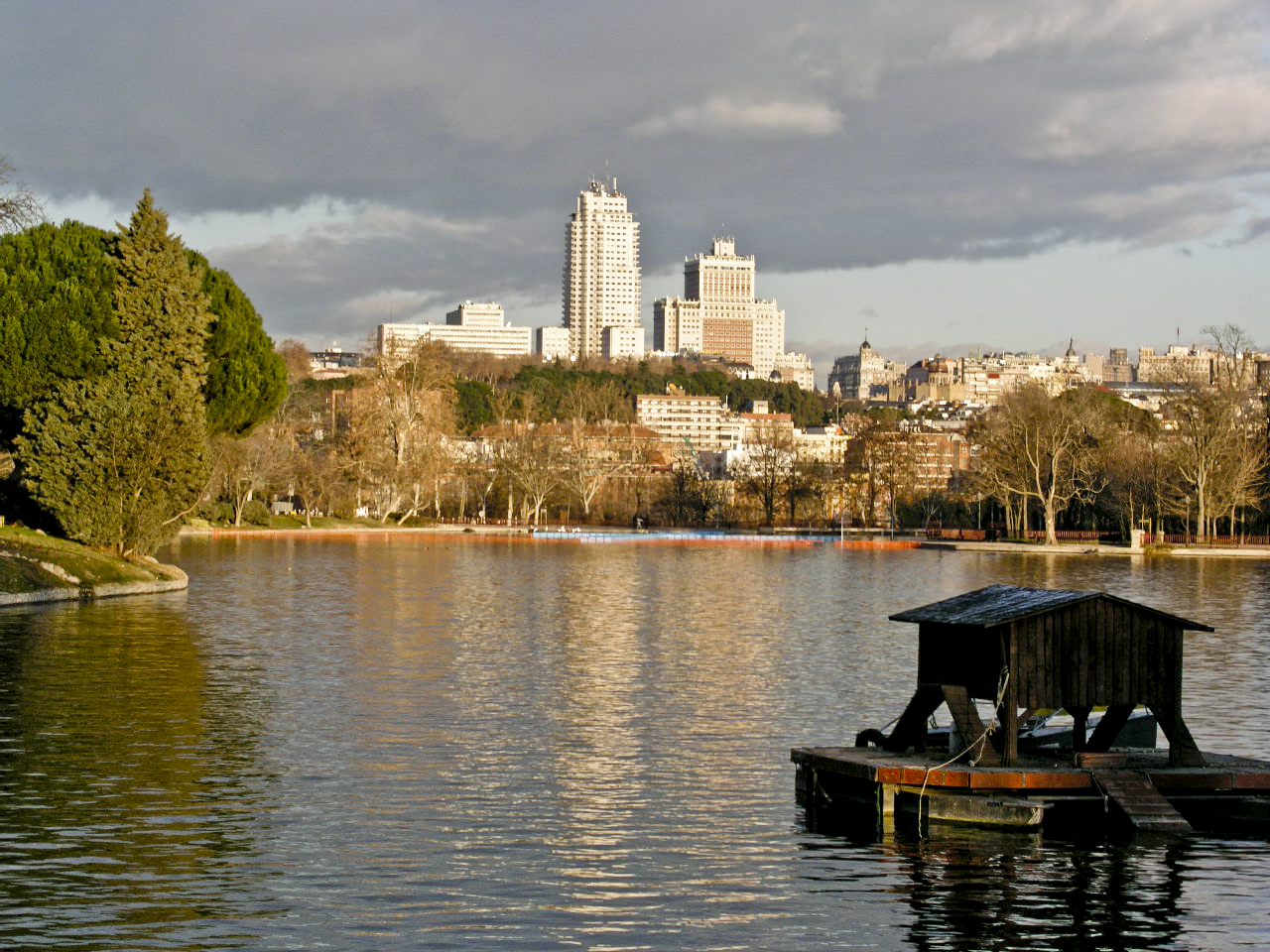
Madrid's largest park at nearly 1,723 hectares — about five times the size of New York's Central Park — with a lake, a zoo, a cable car, and genuine forest.
1,723 hectares, and the decision you make before you go
Casa de Campo is not a park you visit. It is roughly 1,723 hectares of former royal hunting ground west of the Manzanares — about five times the size of New York’s Central Park — and it contains a lake, a zoo, an amusement park, a cable car and a large amount of semi-wild Mediterranean woodland that has nothing to do with any of them. The distance between the zoo, the lake and the cable car station can be a 20 to 30 minute walk each way. Trying to see all of it in a day produces a day of walking between things rather than a day at any of them.
So the useful question is not “is Casa de Campo worth it” but “which Casa de Campo are you going to”. There are effectively four, and they suit different people, different budgets and different metro stops. Entry to the park itself is free and it never closes; only the attractions inside it charge. Pick one, get off at the right station, and treat the rest as scenery.
Rowboats, kiosks and the crowd at El Lago
The artificial lake is the park’s social centre and its default answer. A paved shoreline path circles it, rowboats are for hire, and the far bank gives you Madrid’s skyline across the water — which is the single reason a lot of Madrileños come. It is flat, it is stroller- and wheelchair-friendly, and it is the one part of the park where you are never far from a bar.
Get off at Lago (Line 10) and you are more or less there. Two to three hours covers the lake comfortably. Sunny weekend afternoons here are genuinely busy with local families; weekday mornings are close to empty. Lakeside restaurants and kiosks cluster near the Lago metro stop and are priced accordingly — a picnic carried in and eaten under the pines a few hundred metres uphill costs a fraction and comes with fewer people.
Zoo Aquarium and Parque de Atracciones: the ticketed half
Two full paid attractions sit inside the park boundary, and either one is a day in itself. The Zoo Aquarium de Madrid opened in 1972 and holds roughly 6,000 animals across more than 500 species plus a substantial aquarium, making it one of Spain’s most significant zoos; tickets run roughly €19-26 and hours are 11 AM to 6 or 7 PM depending on season. Booking online in advance is worth doing on weekends and during school holidays, both to skip the ticket line and occasionally to save a few euros against the gate price.
Parque de Atracciones, Madrid’s main amusement park, occupies its own enclosure nearby. Between them these two account for most of the park’s visitor numbers and almost all of its queueing. Batán (Line 10) is the stop for the amusement park; Casa de Campo (Lines 5 and 10) serves the zoo side. If you are travelling with children and have one day, this is the version of Casa de Campo to choose, and the lake makes a reasonable decompression afterwards.
Pine woodland, hills, and the skyline from above the lake
Away from the developed zones the park reverts to what it was: scrubby Mediterranean hillside and pine forest with genuine unpaved trails and real gradient. This is the only part of Madrid where you can walk for an hour without crossing a road, and it is why runners and hikers use it in preference to the tidy loops of El Retiro.
The high ground west of the lake, away from the amusement park, is the part almost no visitor finds — quiet trail walking with skyline views that need no ticket, best in late afternoon when the sun sits behind the city and rim-lights the horizon. Treat it as a short hike rather than a stroll: real shoes, more water than seems necessary, and sun protection, because outside the pine groves there is very little shade and the summer heat on exposed trail is serious. Spring and autumn are the sensible seasons for this version of the park; a check of Madrid’s seasonal weather is more useful here than for most city attractions.
Arriving by gondola rather than by metro
The Teleférico, opened in 1969, crosses the Manzanares valley from Parque del Oeste and is the one arrival that is also an attraction. Roughly €5-7 one way, and the view back toward the Madrid skyline from inside the gondola is a perspective most visitors to the city never get. Its schedule is weather- and season-dependent and it does not run every day of the year, so confirm it is operating before building a plan around it — the eastern station sits beside the Temple of Debod, which makes a natural pairing in either direction.
The alternative approaches are all straightforward: Casa de Campo (Lines 5, 10), Lago (Line 10) and Batán (Line 10) put you inside the park, and Príncipe Pío (Lines 6, 10 and Renfe) leaves a 15-minute walk across the Puente del Rey.
Philip II’s hunting ground, and the Republic that took it
The land was assembled as a royal hunting estate under Philip II in the 1560s, part of a wider Habsburg pattern of enclosing large private grounds around Madrid — the same instinct that produced Campo del Moro beneath the palace. For roughly four centuries it stayed closed: hunting, occasional court functions, no public.
That ended with the Second Republic in the early 1930s, which expropriated the land from the crown and opened it. The gesture was deliberately symbolic — a private royal playground converted into common civic space — and it explains both the park’s scale and its refusal to feel designed. Nothing here was landscaped for strolling, because for most of its history nobody was meant to stroll in it.
The front line ran through here
During the 1936-39 siege of Madrid, Casa de Campo sat directly on the front line. The fighting left the terrain physically marked, and remnants of trenches and fortifications from that period survive in parts of the park for anyone who knows where to look. It is a quieter kind of war site than the preserved bunker at Parque El Capricho across the city, but it covers far more ground.
Post-war development added everything visitors now associate with the place — the lake, the zoo, the amusement park, the cable car — laid over a landscape that had been a battlefield within living memory.
After dark, and the walk back along the river
One honest caveat: parts of the park, particularly the remoter roads away from the lake and zoo, have long had a reputation for street prostitution and other nighttime activity. This is not a daytime visitor concern in any practical sense, but it does mean Casa de Campo is not somewhere to wander alone after dark, and the more remote trails are better walked in company at any hour simply because of the distances involved.
For leaving, the most satisfying route is on foot. Madrid Río runs along the Manzanares directly below the park’s eastern edge, giving a flat, continuous walk back toward the centre without retracing your steps, and it delivers you within reach of the Royal Palace if you still have energy. Failing that, Príncipe Pío has a proper food court and better eating than anything on the lakeside.
Crowd Meter
- Low — Weekday mornings, especially outside the lake and zoo areas
- Medium — Weekend mornings
- Peak — Sunny weekend afternoons around the lake and Zoo Aquarium entrance


Casa de Campo: Quick Answers
What are the opening hours of Casa de Campo?
Park open 24/7 with free access; Zoo Aquarium 11 AM-6 or 7 PM (varies by season); Teleférico cable car has separate, weather-dependent hours
How much does it cost to visit Casa de Campo?
Free to enter the park; Zoo Aquarium roughly €19-26; Teleférico roughly €5-7 one-way
How do you get to Casa de Campo?
Casa de Campo (Line 5, 10), Lago (Line 10), Batán (Line 10), or Príncipe Pío (Line 6, 10, R). 15-minute walk from Príncipe Pío across the Puente del Rey, or direct via the Teleférico cable car from Parque del Oeste
How long should you plan to spend at Casa de Campo?
2-4 hours for a lake and trail visit; a full day if combining the zoo, amusement park, and cable car
Is Casa de Campo good for kids?
The Zoo Aquarium and the Parque de Atracciones amusement park are both inside the grounds, plus paddleboats on the lake — this is one of the best full-day family destinations in Madrid
Is Casa de Campo wheelchair accessible?
Main paths around the lake are flat and paved; the wider park is hilly, unpaved terrain that is not wheelchair-friendly beyond the central areas
Any tips for visiting on a budget?
The park itself is entirely free — you can spend a full day walking, picnicking, and enjoying the lake view without paying for the zoo, amusement park, or cable car at all
Where to Go Next

Madrid Río Park
A 10-kilometer green corridor along the Manzanares River, built over a buried highway, with 33 bridges, an urban beach, and Madrid's best bike path.
 free
freeTemple of Debod
A genuine 2nd-century BC Egyptian temple, gifted to Spain and rebuilt stone by stone in a Madrid park — famous above all for its sunset views.
 must see
Royal Palace of Madrid
Europe's largest functioning royal palace: 3,000+ rooms of Bourbon excess, a world-class armoury, and the last word in Spanish state pomp.