

Spain's vast archaeology collection, from Iberian sculpture to Islamic and medieval Christian artifacts, housed beside Plaza de Colón and largely bypassed by tourists.
If you have one hour
The Museo Arqueológico Nacional — MAN to everyone in Madrid — covers human presence on the Iberian Peninsula from prehistory through the Islamic and medieval Christian centuries. A full chronological walk takes longer than most people give it. If you only have an hour, do this: the Altamira replica in the basement, the Dama de Elche, the Roman courtyard, and the Visigothic crowns. That is four stops, roughly in the museum’s own running order, and it gives you the shape of the collection without the archaeology degree.
Everything below expands that list. The rest of the building rewards a slower visit — 90 minutes to two hours is the honest figure for a proper look — but the four stops are the spine.
The museum’s other advantage is that almost nobody is in it. It sits on Calle de Serrano beside Plaza de Colón, geographically inside the tourist zone and psychologically outside it, because the crowds on Serrano are shopping. Pickpocket vigilance and crowd navigation, the standing concerns of the Golden Triangle, are non-issues here.
Prehistory, and the cave you cannot otherwise enter
The basement holds a full-scale, faithful reproduction of the painted ceiling of the Altamira cave in Cantabria. The original is closed to public visits to protect paintings made roughly 14,000 years ago, so this is as close as almost anyone will get, and it is the single strongest reason to bring children who like ancient history. The surrounding prehistoric galleries were rebuilt with the rest of the museum in a comprehensive renovation completed in 2014, which added lighting, interpretive text and accessible routes without touching the original architecture.
The Dama de Elche is smaller than you expect
The museum’s famous object is a limestone bust roughly the size of a large melon. The Dama de Elche is an Iberian carving from the 4th century BCE, discovered in 1897, and scholars still argue about what she represents — a goddess, a priestess, or an idealised noblewoman. She anchors the ancient Iberian galleries.
Because she is small and singular, she does not generate the standing wall of visitors that a large painting does. This is a museum where you can spend ten minutes in front of its best-known object with nobody behind you, which is not true of anything comparable in the city.
Rome in Hispania
The Roman holdings are where the museum’s real depth starts to show: mosaics and sculpture gathered from across Hispania, displayed most impressively in the Roman courtyard gallery, a light-filled space with mosaic flooring and long sightlines. It is the best interior photograph in the building, and photography without flash is broadly permitted throughout the permanent galleries.
Visigothic gold
The Treasure of Guarrazar — votive crowns and crosses in gold, hung so the light catches them — is one of the finest surviving collections of Visigothic goldsmithing anywhere in Europe, and it covers a period most visitors to Spain never encounter at all. It is a short section and an easy one to walk through too fast.
Al-Andalus on the lower level
The Islamic-era ceramics and ivory-carving galleries are the museum’s most consistently overlooked rooms, passed over by visitors who stop after the Iberian and Roman sections. They hold some of its richest material: work from the centuries when Al-Andalus was among the most technically sophisticated societies in Europe. Give them fifteen minutes you had allocated somewhere else.
Taken together with the medieval Christian collection that follows, this is a walk through Spain before Spain existed as a concept — Iberian, Celtic, Phoenician, Roman, Visigothic, Islamic and medieval Christian cultures, each in genuine depth rather than a token case.
Why the building looks like that
The museum was founded by royal decree of Queen Isabella II in 1867, part of a wave of 19th-century European institution-building aimed at consolidating national archaeological identity. Its purpose-built neoclassical home opened in 1892, shared with the Biblioteca Nacional, and was designed to project the same institutional weight as the Prado a few blocks south. The grand outdoor staircase on the Serrano facade photographs best in morning light, before the surrounding buildings put the street in shadow.
The thick stone and the modern climate control together make the interior noticeably cooler than the pavement in July and August, and the same building is an obvious wet-weather option in winter without the queues that indoor alternatives elsewhere attract.
€3, no booking, and a museum that never fills
General admission is €3, with a €1.50 reduced rate for pre-arranged groups of more than eight. Under-18s and over-65s enter free at all times, and entry is free for everyone on Saturdays from 14:00 and on Sunday mornings, plus April 18, May 18, October 12 and December 6. For the depth of collection, this is among the best-value tickets in Madrid.
Advance booking is essentially never necessary — walk-up tickets are almost always available. Opening hours are Tuesday to Saturday 09:30-20:00 and Sunday and holidays 09:30-15:00, closed Mondays. Any weekday is quiet and so are most weekends; Saturday afternoons from 14:00 tick up slightly, and free Sunday mornings are the closest this place comes to a peak, which is nothing like the Reina Sofía on a free morning.
The building is fully wheelchair accessible after the 2014 works, with elevators and accessible routes throughout — a sharp contrast to Madrid’s older stair-heavy house-museums such as the Museo Cerralbo. There is a cloakroom near the entrance, a small café, and a gift shop whose archaeology books are better than most in the city.
Serrano, Colón, and where to go from here
Getting here is easy: Serrano or Colón on Line 4 are both under five minutes’ walk, Retiro on Line 2 about ten, and Puerta del Sol is a 20-minute walk down Calle de Alcalá.
Plaza de Colón is directly next door, with its Columbus monument and a useful orientation point for northern Madrid. Puerta de Alcalá, one of the city’s grand ceremonial gates, is about ten minutes south down Calle de Alcalá, with El Retiro immediately beyond it if you want green space after two hours of stonework. The Museo Lázaro Galdiano is a further fifteen minutes up Calle Serrano and pairs naturally with MAN as the second serious collection in this district that most visitors never open the door of.
For food, the streets around Calle Serrano run to upscale tapas bars and pastry shops. Prices are a step above central Madrid, and a post-museum coffee is worth paying them for.
Crowd Meter
- Low — Any weekday, and even most weekends
- Medium — Saturday afternoons from 14:00
- Peak — Rarely crowded; the closest this museum gets is a modest uptick on free Sunday mornings


Where to Stay Near National Archaeological Museum (MAN)
Real current prices via Agoda. Dates shown are indicative — pick your own on the next step.
National Archaeological Museum (MAN): Quick Answers
What are the opening hours of National Archaeological Museum (MAN)?
Tue-Sat 09:30-20:00; Sun and holidays 09:30-15:00. Closed Mondays
How much does it cost to visit National Archaeological Museum (MAN)?
€3 general admission; €1.50 reduced rate for pre-arranged groups over 8 people. Free for under-18s and over-65s at all times; free for everyone Saturdays from 14:00 and Sunday mornings; also free April 18, May 18, October 12, and December 6
How do you get to National Archaeological Museum (MAN)?
Serrano or Colón (Line 4), both under 5 minutes' walk; Retiro (Line 2) about 10 minutes. 20-minute walk from Puerta del Sol via Calle de Alcalá
How long should you plan to spend at National Archaeological Museum (MAN)?
1.5-2 hours for the highlights, longer for a full chronological walk
Is National Archaeological Museum (MAN) good for kids?
Excellent for kids interested in ancient history — the museum includes hands-on interpretive displays and a genuinely impressive prehistoric and Roman collection that plays well with school-age curiosity
Is National Archaeological Museum (MAN) wheelchair accessible?
Fully wheelchair accessible following a major 2014 renovation, with elevators and accessible routes throughout
Any tips for visiting on a budget?
At €3 full price with generous free windows, this ranks among Madrid's best-value museums for the depth of collection on offer
Where to Go Next
 iconic
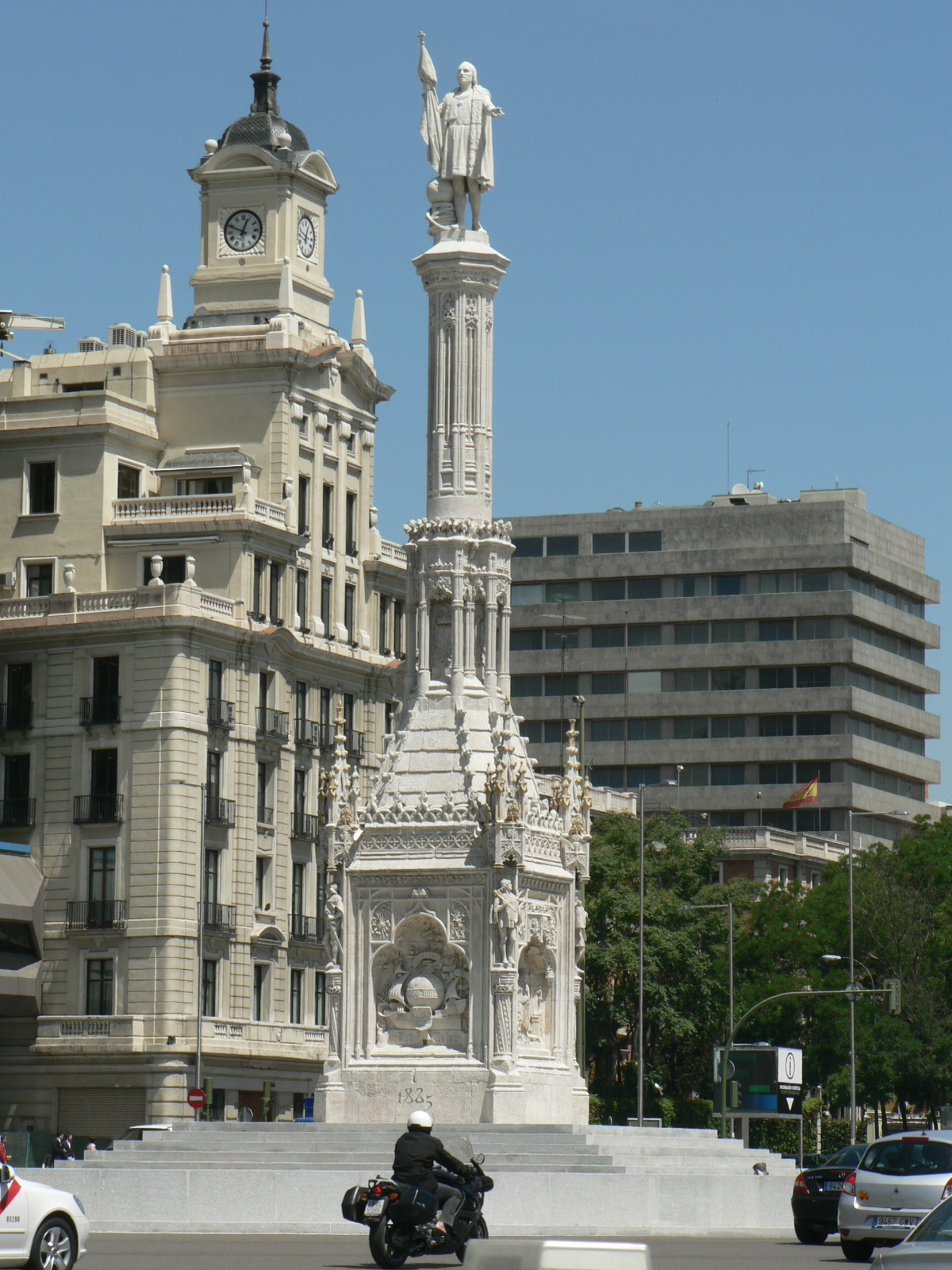
Plaza de Colón
A grand square anchored by a towering Neo-Gothic monument to Christopher Columbus and one of the world's largest Spanish flags flying overhead.
 iconic
Puerta de Alcalá
A grand five-arched neoclassical gate from 1778, once the ceremonial entrance to Madrid, standing free-standing in its own plaza by Retiro Park.

Museo Lázaro Galdiano
A publisher's private art collection of some 12,600 pieces, from Bosch and Goya to English portraiture, housed in his own Salamanca-district palace.