
Madrid sorted by the age of the child you are travelling with, from toddler-scale parks to teenager-proof stadium tours, plus the eating clock nobody warns you about.
Most family guides to Madrid list the same ten things and leave you to work out whether any of them suits a three-year-old or a fifteen-year-old. Those are completely different trips. A toddler needs short distances, shade and somewhere to be put down; a nine-year-old wants a boat, a cable car and something to climb; a teenager wants a stadium, a skate park and to be left alone with their phone.
So this is organised by age first, then by the three practical problems that catch visiting families out here — the eating clock, the stroller situation, and the museum question.
Under 5: short distances and somewhere to put them down
The winning strategy with toddlers in Madrid is a park in the morning, lunch, a flat, an afternoon in a plaza. Distances defeat everything else.
Madrid Río is the strongest single answer in the city and the most under-visited by tourists. Seventeen playgrounds are spread along the corridor, and the Arganzuela section in the south has the urban beach: three shallow oval pools and water jets, running seasonally through the hot months, entirely free. Next to it is the slide hill, which has eight giant slides built into an embankment. Arganzuela also has the best restrooms and drinking fountains on the route, which matters more than it sounds. Metro Pirámides or Marqués de Vadillo, both Line 5. The whole corridor is flat, paved and continuous — the easiest stroller terrain in Madrid.
El Retiro works for this age if you enter at the right gate. The Puerta de Dante in the southeast is the family gate, with a playground close by, and the Teatro de Títeres puppet theatre near the old Casa de Fieras runs on weekends and is a reliable hit with small children. Main paths are flat and paved; the Parterre and Rosaleda gravel is harder going after rain.
Plaza de Oriente is the best central square for this age — benches, greenery, statues to run between, and no traffic — and it sits directly beside the Royal Palace, which means one adult can do the palace while the other stays outside. The Temple of Debod does a similar job on the other side of the palace: open grass around an actual Egyptian temple, free, and the standard decompression stop after anything indoors.
Skip: the Royal Botanical Garden at this age. It is €4 and lovely, but it is a place for looking closely at plants, not for running, and small children reliably hate it.
5 to 11: the age Madrid is actually built for
This is the sweet spot. Primary-age kids can walk far enough to reach things and are old enough for the paid attractions to land.
Boating on the Estanque Grande in El Retiro is the classic, and it is cheap: rowing boats are around €6 for 45 minutes. It also happens to be the best angle on the Alfonso XII colonnade, so nobody is being humoured.
Casa de Campo is the full-day option and contains three separate draws. The Zoo Aquarium holds roughly 6,000 animals across more than 500 species plus a substantial aquarium; tickets run roughly €19–26, hours 11:00 to 18:00 or 19:00 depending on season, and booking online is worth it on weekends and school holidays. Parque de Atracciones, Madrid’s main amusement park, has its own enclosure nearby — Batán (Line 10) is its stop, while Casa de Campo (Lines 5 and 10) serves the zoo side. And the Teleférico cable car crosses the Manzanares valley from Parque del Oeste for roughly €5–7 one way, arriving over the treetops instead of underground. Its schedule is weather- and season-dependent and it does not run every day of the year, so confirm before promising it to anyone.
Pick one of those three. Trying to do the zoo and the amusement park in one day is how you end up carrying a crying child across a 1,723-hectare park.
Parque El Capricho is the wildcard: an 18th-century romantic garden with a hedge maze and a real Civil War bunker underneath it. The catch is severe — it opens weekends and public holidays only, with a visitor cap, 09:00–18:30 October to March and 09:00–21:00 April to September. It is also not central: metro El Capricho (Line 5) is a real 20–25 minute walk from the gate, and buses 101, 105 and 151 stop closer. Treat it as a half-day expedition, not a stop.
For rainy days, the National Museum of Natural Sciences (MNCN) on Calle José Gutiérrez Abascal is the standard local answer for this age — dinosaur casts, a big taxidermy hall, and modest admission. The Naval Museum on Paseo del Prado and the Railway Museum in the old Delicias station work well for specific obsessions. None of the three is covered elsewhere on this site, so check their current hours directly; the Naval Museum in particular has changed its admission arrangements in recent years.
12 and up: stadiums, street culture and being trusted
Teenagers do better in Madrid than younger children, because the city’s real pleasures — walking, eating in the street, staying out late — are things they can join in.
Stadium tours are the highest-conversion activity for football-obsessed teenagers. The Santiago Bernabéu tour runs from roughly €25–30 booked online, covering the museum, pitch-level view and dressing rooms, with premium and Skywalk packages from about €45 to €120. The whole ground was rebuilt in a roughly €1 billion renovation, and the interactive museum holds attention well past the usual threshold. Book online — it is cheaper than the box office and locks in an entry window. Across the city, the Riyadh Air Metropolitano tour starts around €20, is self-guided, takes about 90 minutes, and is a far easier ticket to get at short notice. Neither folds into a central walking day: the Bernabéu is on Line 10 at its own stop, the Metropolitano is a long haul out east on Line 7, and both need roughly an hour door to door each way.
Matadero Madrid, the converted slaughterhouse arts complex in Arganzuela, is the one cultural venue teenagers tend not to resent — contemporary exhibitions, film, design, open plazas, and it connects straight into Madrid Río, so a stadium-averse sibling can be sent to a playground.
For older teenagers, the Reina Sofía is the museum most likely to land, because Guernica is one painting they have probably already met in a classroom. Entry is €12, free every Saturday 14:30–21:00 and Sunday 10:00–14:30, and free at all times for under-18s and students aged 18–25 with ID. It is closed Tuesdays.
The museum question, honestly
The Prado is hard work with young children, and pretending otherwise ruins afternoons. It is enormous, quiet, and the crowds around Las Meninas get physically tight. It is genuinely manageable from about age eight with a focused 90-minute route — the free family trail leaflet at the information desk is the tool for this — and Goya’s Black Paintings in Room 67 tend to be the thing older kids remember. Under-18s are free at all times, so the calculation is only about attention, not money. Strollers are fine and the building is fully accessible with free wheelchair loans.
The easier wins are elsewhere. The National Archaeological Museum is €3, never fills up, has hands-on interpretive displays, and holds a full-scale reproduction of the Altamira cave ceiling in the basement — the single best museum room in Madrid for a child who likes ancient history. Under-18s and over-65s are free at all times, and it is free for everyone Saturdays from 14:00 and Sunday mornings. It is fully accessible after its 2014 rebuild, unlike the older stair-heavy house-museums.
At the Royal Palace, the Royal Armoury — suits of armour, swords, horse barding — holds children’s attention far better than the state rooms. The no-running, no-touching formality wears thin under about age eight, so do the Armoury first rather than saving it.
Three practical problems nobody warns you about
The eating clock is the hardest part of Madrid with young children. Kitchens serve lunch from roughly 13:30 or 14:00 to 16:00, then close, and dinner does not properly start until 21:00 or later. A five-year-old on a northern European schedule wanting dinner at 18:00 will find almost nothing open. The workarounds are real: eat the big meal at lunch as locals do; use tapas bars in the 19:00–20:30 gap, where a plate of croquetas or tortilla can be had at the counter any time; and accept that Spanish children genuinely do eat late and are welcome in restaurants at hours that feel wrong. The merienda — a mid-afternoon snack around 17:30 — is the cultural mechanism that makes it work, so adopt it.
Terrace plazas are the local solution to the adult-sitting problem. The move is a square where children can run in sight while adults sit with a drink: Plaza de Oriente is the best of them, and Plaza de la Paja in La Latina is the other — leafy, enclosed, genuinely pleasant with children during the day. Time La Latina carefully, though: from Sunday early afternoon the Cava Baja tapeo crowd is dense, loud and firmly adult, and the barrio is hilly, cobbled and uneven throughout, which makes it one of the harder central neighbourhoods with a stroller.
Metro accessibility is inconsistent. The network has 12 lines and over 300 stations, and a large share of central stations are step-free, but not all — older central stops in particular can mean two flights of stairs with no lift. Check the station, not the line. A single ride is around €1.50–2.00 and a Tarjeta Multi costs €2.50 to buy before loading; children under four travel free. The full ticketing picture is in getting around Madrid. Where the metro is awkward, the alternative is that Madrid’s centre is small: Sol to the Royal Palace is about fifteen minutes on foot, and the flat riverside corridor at Madrid Río is easier with wheels than any underground journey.
If you are building the days out, the parks and gardens roundup covers the closure traps in more detail, and the free things to do list is disproportionately useful with a family, since almost everything outdoors here costs nothing.


Where to Stay Near Madrid with Kids: What Works at Which Age
Real current prices via Agoda. Dates shown are indicative — pick your own on the next step.
Related Guides


Covered in this guide

Madrid Río Park
A 10-kilometer green corridor along the Manzanares River, built over a buried highway, with 33 bridges, an urban beach, and Madrid's best bike path.
must seeEl Retiro Park (Parque del Buen Retiro)
A 350-acre royal park with a rowing lake, a rose garden, and shaded avenues where Madrid comes to walk, picnic, and breathe.
Plaza de Oriente
A peaceful, sculpture-lined garden square between the Royal Palace and the Royal Theatre, ringed by statues of Spanish monarchs and a bronze of Felipe IV.
freeTemple of Debod
A genuine 2nd-century BC Egyptian temple, gifted to Spain and rebuilt stone by stone in a Madrid park — famous above all for its sunset views.
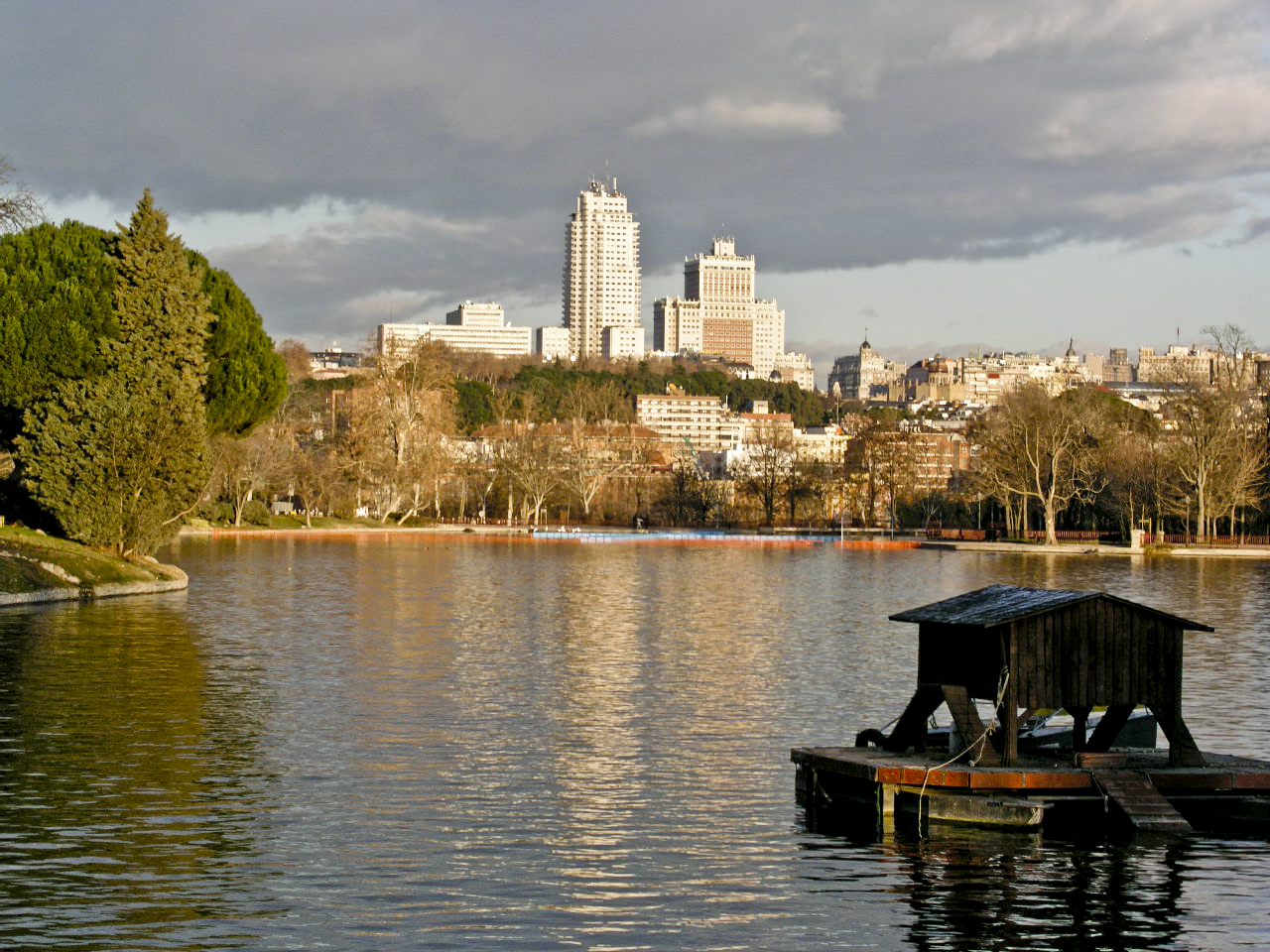
Casa de Campo
Madrid's largest park at nearly 1,723 hectares — about five times the size of New York's Central Park — with a lake, a zoo, a cable car, and genuine forest.

National Archaeological Museum (MAN)
Spain's vast archaeology collection, from Iberian sculpture to Islamic and medieval Christian artifacts, housed beside Plaza de Colón and largely bypassed by tourists.