
Eight green spaces sorted by what you actually want from them — an hour off your feet, a long walk, a photograph nobody else has, or somewhere to let children run.
Ranking parks is a mostly useless exercise. El Retiro wins every list and deserves to, and knowing that tells you nothing about whether it is the right place to spend the next two hours. A 350-acre park is a bad answer to “I need to sit down for forty minutes”, and an excellent one to “we have children and an afternoon”.
So this is sorted by what you want instead. Read the closures section first, though — three of these have a scheduling problem that has ruined more visits than bad weather ever has.
Three things that will waste your morning
Parque El Capricho opens on Saturdays, Sundays and public holidays only. No weekday access, for anybody, at any time of year. It is the single most common reason visitors arrive at a Madrid park gate and find it shut.
Campo del Moro cannot be entered from the Royal Palace. The gardens sit directly below the palace on the river side, and there is no public way down into them from the palace, from Plaza de Oriente, or from Calle Bailén. The only entrance is at the bottom, at river level.
The Palacio de Cristal is closed inside until roughly 2027. The glass pavilion in Retiro has been shut since structural problems were identified in 2023 and is undergoing a multi-year restoration of its ironwork and glazing. The exterior — which is the famous image anyway — is entirely unaffected.
You want to sit down for an hour and stop walking
Two gardens do this better than anywhere in central Madrid, and neither of them is Retiro, because Retiro requires walking to get anywhere in it.
The Royal Botanical Garden shares a wall with the Prado and its gate on Plaza de Murillo is a two-minute walk from the museum’s south entrance. Admission is €4, bought at the gate, no booking. That is close to the best value in the museum quarter: eight hectares of terraced planting, around 90,000 plants, and reliably low crowds for the simple reason that most Prado visitors never register that it is there.
The layout is three terraces, and knowing which is which saves you wandering. The lower one, just inside the Puerta Real gate, holds the taxonomic beds laid out by plant family — the busiest part, because groups drifting over from the museum rarely go further. Head up and to the right and the visitor count falls off sharply within two minutes; the upper terrace, with the roses and the medicinal beds, is reliably the emptiest ground in the garden. Five climate zones sit under glass in the greenhouses, which are punishing at midday in July and one of the pleasantest rooms in the city in January.
Hours track the season closely: 10:00–18:00 November to February, 10:00–19:00 in March and October, 10:00–20:00 in April and September, and 10:00–21:00 May to August. Entry is free Tuesdays 10:00–13:00, though that window pulls a bigger crowd than an ordinary weekday — at €4, restructuring a trip around it is rarely worth it. Budget 45 to 90 minutes. There is no café inside. As a deliberate pause between the Prado and the Thyssen-Bornemisza, it is better use of an hour than pushing straight on, and CaixaForum sits directly across the avenue.
Sabatini Gardens, on the north side of the Royal Palace, is the twenty-minute version. Three shallow terraces of clipped parterres, a reflecting pool, and statues of Spanish monarchs — carved for the palace roofline, never installed there, and now standing at eye level in a garden. It is free, always, with no ticket. Anyone telling you to set aside an afternoon here has not been. The gardens exist to frame the building behind them and they do that superbly, which is a different thing from being somewhere you spend time. Ópera (Lines 2, 5, R) or Plaza de España (Lines 2, 3, 10); Plaza de Oriente is five minutes away and is where you go if you want an actual chair.
You want a long walk without crossing a road
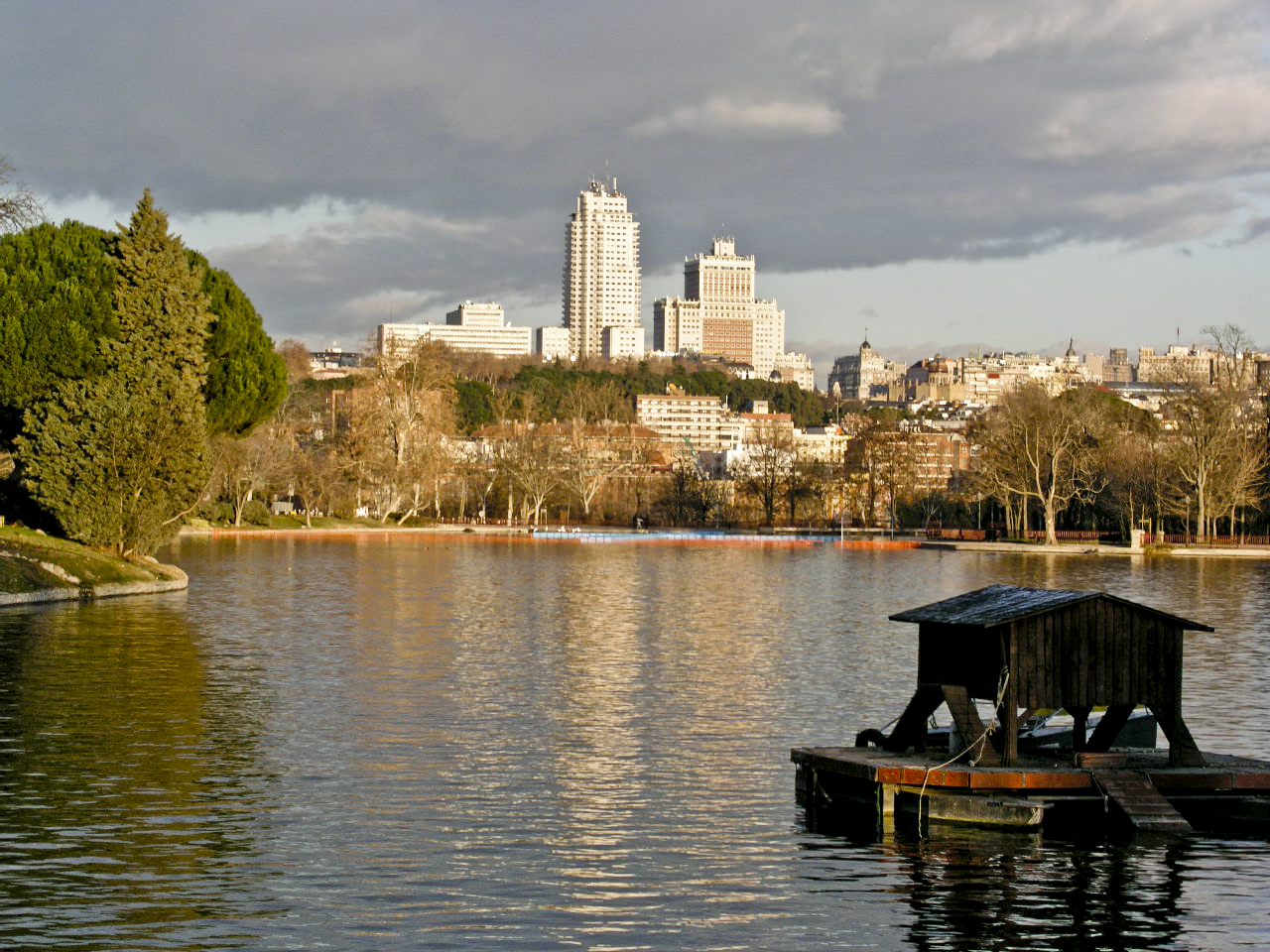
Casa de Campo is roughly 1,723 hectares of former royal hunting ground — about five times the size of Central Park — and it is the only place in Madrid where you can walk for an hour without meeting traffic. It is also not a park you visit; the distance between the zoo, the lake and the cable car station can be a 20 to 30 minute walk each way, so an attempt at all of it produces a day spent walking between things.
Pick one zone and get off at the right station. The lake (Lago, Line 10) is the default: a flat paved shoreline path, rowboats, bars, and Madrid’s skyline across the water. Two to three hours, stroller- and wheelchair-friendly, close to empty on a weekday morning. The high ground west of the lake is the version almost nobody finds — unpaved trails, real gradient, skyline views at late afternoon when the sun sits behind the city. Treat that one as a short hike: real shoes, more water than seems necessary, very little shade outside the pine groves. The park itself is free and never closes.
The best arrival is the Teleférico cable car from Parque del Oeste, roughly €5–7 one way, with the view back toward the skyline that most visitors never get. Its schedule is weather- and season-dependent and it does not run every day, so confirm before building a plan around it. The eastern station sits beside the Temple of Debod.
One caveat worth stating plainly: the remoter roads away from the lake and zoo have long had a reputation for nighttime activity, and this is not a park to wander alone after dark.
Madrid Río is the flat alternative — ten kilometres of green corridor along the Manzanares, built over a buried motorway, open 24/7 and free along its entire length. There is no centre and no viewpoint from which it resolves into a single place, so the whole planning exercise is picking a stretch.
The northern stretch from Príncipe Pío down to Puente del Rey is the hour-long historic walk: it runs beneath the Royal Palace and connects directly to Campo del Moro’s river-level gate. Just south of Puente del Rey, along the bank facing Casa de Campo, is the quietest good stretch of the whole corridor, with the wooded hills opposite giving the best river views on the route. The middle section is where the 33 bridges cluster — Puente de Segovia and Puente de Toledo, both centuries old and both marooned in traffic until the motorway went underground, and the modern 278-metre Puente de Arganzuela, whose two curved white sections meet on an artificial hill you can climb.
Flat and paved for kilometres without interruption, it is in practical terms the most wheelchair- and stroller-friendly outdoor space in the city, and a completely different proposition from Retiro’s slopes and gravel. It is also the only park here best experienced by bike. Early evening is when it is most itself. For food, Matadero Madrid near the southern end has a food market and river-facing terraces; the riverside path itself has almost nothing.
You want the photograph
Three specific frames, and only one of them is the obvious one.
The Palacio de Cristal reflected in its pond. Take it from the small bridge at the pond’s edge on the northeast side, framing the 1887 pavilion’s Greek-cross silhouette centred in its own reflection, vertical rather than wide. Late afternoon turns the glass gold instead of the flat white it reads as at midday. The closure changes nothing here — this shot was always an exterior one. Go round the back, away from the pond side, for an uncluttered view of the iron ribs, and get close to the brick base for the ceramic tilework, a very Spanish detail on a very British kind of building.
The Royal Palace’s west facade from Campo del Moro. Campo del Moro exists in almost no tourist photograph of the palace, because almost nobody makes the walk. From the lower garden the west facade rises above the trees on its terrace, and that angle does not exist from Plaza de Oriente, from the courtyard, or from anywhere else. Come in the morning — the garden faces west, so by late afternoon the building is backlit and flattens into a silhouette.
Sabatini after dark. The gardens close at 22:00 May to September and 21:00 October to April, long after the palace has emptied, and that gap is the whole argument for coming. By day the open geometry has no shade and the parterres read flat. After sunset the north facade is floodlit, the light drops into the reflecting pool, and the composition the gardens were built to produce finally arrives — shoot from the lower terrace, past the hedges, with the pool as a mirror. The few minutes when the stone is already lit but the sky still holds blue are the best of the day. In winter, against a cold clear sky, better still.
If you are touring the palace during the day, do not treat Sabatini as a same-visit add-on. Come back in the evening.
You have children and need them to run
Madrid Río wins this outright in summer. Arganzuela Park at the southern end holds the urban beach — three oval shallow pools and water jets, running seasonally through the hot months and one of the very few free ways to cool off outdoors in Madrid in July and August. The slide hill next door has eight giant slides, and there are seventeen playgrounds spread along the corridor. It has the best restrooms and drinking fountains on the route, which matters with children. Pirámides or Marqués de Vadillo, both Line 5. Hot weekend afternoons are genuinely crowded; go in the morning if you want space in the pools.
Casa de Campo is the full-day option: the Zoo Aquarium (roughly €19–26, 11:00 to 18:00 or 19:00 by season, about 6,000 animals) and Parque de Atracciones sit inside the park boundary, either one a day in itself. Batán (Line 10) for the amusement park, Casa de Campo (Lines 5, 10) for the zoo side. Book the zoo online on weekends and school holidays.
Retiro handles the low-effort version. Rowing boats on the Estanque Grande are around €6 for 45 minutes, the Teatro de Títeres puppet theatre near the Casa de Fieras runs weekends and is a reliable hit, and there is a playground near the Puerta de Dante entrance in the southeast — the family gate. Main thoroughfares are flat, paved and good for strollers; the Rosaleda and several garden paths turn to loose gravel that is harder going after rain.
Campo del Moro has peacocks roaming the grounds, which is usually the detail children remember, and mature tree cover that makes it one of the few genuinely shaded green spaces in the historic core.
You want Retiro done properly
Which gate you use effectively selects your itinerary, and entering from the wrong side costs half an hour of backtracking across a park bigger than many towns.
Puerta de la Independencia, beside Puerta de Alcalá at the northern corner, is the best general-purpose choice — a short walk from the Estanque Grande, and it lets you loop the lake and the Palacio de Cristal without doubling back. Metro Retiro (Line 2) is right there. Puerta de Murillo, on the western edge, is the museum-day gate, facing the Botanical Garden and ten minutes from the Prado. The southern gates, from Ibiza (Line 9) or Príncipe de Vergara (Lines 2, 9), open onto the quieter half — the Rosaleda, the Fallen Angel fountain, the long shaded paths where crowd density drops sharply.
The park is open daily 6:00 to midnight from April to September and 6:00 to 23:00 from October to March. It is free and always has been; only the boats and the puppet theatre cost anything.
Three things off the main axis are worth the detour, and most visitors never leave the lake-to-Cristal corridor. La Rosaleda, the rose garden modelled on Bagatelle in Paris, peaks from late spring into early summer. The Fountain of the Fallen Angel, from 1922, is reputedly the only public monument anywhere dedicated to Lucifer. The Bosque del Recuerdo, near the Menéndez Pelayo gate, is 192 olive and cypress trees, one for each victim of the 2004 train bombings, and the most contemplative corner of the park.
Ninety minutes covers a lake-and-Cristal loop; a half-day if the Rosaleda and the southern paths are on the list. Before 10:30 on a weekday it is close to empty. Sunday afternoon is Retiro at full volume — street performers, book sellers, the whole city at once. Neither version is wrong, but choose deliberately. Skip the kiosks, which price for a captive audience; a bocadillo bought on Calle de Alcalá on the way in, or cheese and charcuterie from one of Madrid’s food markets, makes a better lunch on the grass. Leaving by the Puerta de Felipe IV puts you in Barrio de las Letras, where the coffee is considerably better than anything inside.
You have a free Saturday and want to earn something
Parque El Capricho is the hardest park in Madrid to visit and the most interesting one to have visited. It is an 18th-century romantic garden begun in 1787 by María Josefa Pimentel, ninth Duchess of Osuna, who kept adding to it personally for decades: winding paths, a lake, a clipped hedge maze, an Ionic-columned Temple of Bacchus above the water, and an iron bridge from 1830 reputed to be the first built in Spain. Underneath the lawns is Posición Jaca, a Republican command bunker from the Civil War — a pleasure garden from the age of Goya sitting directly on a hardened wartime command post, both preserved, on the same few hectares.
Now the cost. It opens Saturdays, Sundays and public holidays only: 9:00–18:30 October to March, 9:00–21:00 April to September, closed 25 December and 1 January. Entry is free but capacity is capped at 1,000 people inside at once — no ticket, no booking, no queue-jumping, just a hard number and a wait outside when it is reached. It is in Alameda de Osuna in the northeast, near the airport, and not walkable from anywhere. The metro is El Capricho (Line 5), a real 20 to 25 minute walk from the gate; buses 101, 105 and 151 stop closer. There are no cafés inside and the surrounding streets are residential.
Because it is closed five days a week, there is no quiet-weekday strategy — every visit you can make happens inside its busiest window by definition. Be there at 9:00. That clears the cap, gives you the grounds at their emptiest, and with 1.5 to 2.5 hours inside has you out by late morning with the day intact. The bunker is guided-tour-only, reservation required, small groups, on a seasonal schedule — book it first and build the visit around the slot. The far eastern sections, away from the maze and the templete, are genuinely empty even on a busy Sunday.
Is it worth it? If you have three days in Madrid, no. If you have a week, or a Saturday with nothing on it, yes — and it is close enough to Barajas that an early departure or late arrival can be built around it, which is the one efficient pairing it has. The flights guide is worth a look if that is how your trip is shaped.
Quick reference
| Cost | Open | Time needed | |
|---|---|---|---|
| El Retiro | Free | Daily 6:00–24:00 (Apr–Sep), to 23:00 (Oct–Mar) | 1.5–3 hrs |
| Royal Botanical Garden | €4 | Daily from 10:00, closing 18:00–21:00 by season | 45–90 min |
| Sabatini Gardens | Free | 9:00–22:00 (May–Sep), to 21:00 (Oct–Apr) | 20–40 min |
| Campo del Moro | Free | 10:00–20:00 summer, 10:00–18:00 winter | 45–60 min |
| Casa de Campo | Free (attractions charge) | 24/7 | 2–4 hrs |
| Madrid Río | Free | 24/7 | 1–2 hrs |
| Parque El Capricho | Free, 1,000-person cap | Sat, Sun & holidays only | 1.5–2.5 hrs |
Season changes these places more than it changes Madrid’s museums. Spring brings the wisteria and the roses; October and November turn Retiro’s Paseo de las Estatuas over to the leaves and are arguably the best weeks of the year. July and August make shade the scarce resource everywhere except Campo del Moro’s tree cover and Casa de Campo’s pine groves — the seasonal weather guide has the fuller picture, and getting around Madrid covers the metro lines that reach the further ones. Almudena Cathedral closes the loop on the palace block if you are combining the two royal gardens in one circuit.


Where to Stay Near The Best Parks and Gardens in Madrid
Real current prices via Agoda. Dates shown are indicative — pick your own on the next step.
Related Guides

Covered in this guide
 must see
El Retiro Park (Parque del Buen Retiro)
A 350-acre royal park with a rowing lake, a rose garden, and shaded avenues where Madrid comes to walk, picnic, and breathe.
Royal Botanical Garden (Real Jardín Botánico)
An 8-hectare walled garden next to the Prado with thousands of plant species, terraced walkways, and a calm that the surrounding avenues don't have.
freeSabatini Gardens (Jardines de Sabatini)
Neoclassical, symmetrical gardens on the Royal Palace's north side, built where the royal stables once stood, with the best framed view of the palace facade.
Campo del Moro
English-style romantic gardens behind the Royal Palace, named for a 12th-century Moorish siege camp, with fountains and the palace's most dramatic facade view.
Casa de Campo
Madrid's largest park at nearly 1,723 hectares — about five times the size of New York's Central Park — with a lake, a zoo, a cable car, and genuine forest.

Madrid Río Park
A 10-kilometer green corridor along the Manzanares River, built over a buried highway, with 33 bridges, an urban beach, and Madrid's best bike path.