
A calendar of the Madrid Christmas season, from the November lights switch-on to the Three Kings parade, with the closure dates that quietly ruin itineraries.
Madrid’s Christmas is not a single event you can turn up for. It is a six-week season with a fixed skeleton — lights on in late November, market in Plaza Mayor through December, grapes at midnight on the 31st, and the parade that actually matters on 5 January — wrapped around a set of closure dates that will quietly wreck a badly planned itinerary.
Below is the season in order, with what is worth your time and what is not. Exact dates shift by a day or two each year and prices creep, so the specifics here are from the most recent season (2025–26) and should be read as the shape of the thing rather than a guarantee. Confirm the current year’s dates before you book anything around them.
Late November: the lights go on, and the season starts
The official switch-on (el encendido) happens in the second half of November, usually on a Friday or Saturday evening. In 2025 it was 22 November at 19:30, staged at Plaza de Cibeles, with the lights then running to 6 January. The city put more than 13 million LED bulbs across 240-odd locations in all 21 districts that year — a scale that has been climbing annually and is unlikely to shrink.
The switch-on itself is a crush, and you do not need to attend it. The lights are there for six weeks afterwards, and they are better seen on an ordinary Tuesday. Typical hours are roughly 18:00 to midnight, extended to around 01:00 on Fridays and Saturdays. The heaviest concentrations are along Gran Vía, around Cibeles and Puerta de Alcalá, on Calle Preciados and Calle Fuencarral, and up Paseo de Recoletos toward Plaza de Colón. Cibeles has in recent years also carried a video-mapping projection onto the Palacio de Cibeles facade, which is the one element genuinely worth timing a walk around.
Be realistic about the crowds. Gran Vía and the Preciados–Sol axis on a December Saturday evening are shoulder-to-shoulder, and the pedestrian flow around Puerta del Sol is sometimes made one-way by police. Weeknights before about 20:30 are the difference between a pleasant walk and a slow shuffle.
Late November to 31 December: the Plaza Mayor market
The Mercado de Navidad in Plaza Mayor is the oldest and most characterful of Madrid’s Christmas markets, and it is not a German-style Weihnachtsmarkt. Do not come for mulled wine and craft stalls. It runs roughly from late November to 31 December — in 2025, from 27 November, with about 104 wooden casetas — and the hours are typically 10:00 to 21:00, extended to 22:00 on Fridays, Saturdays and the eve of public holidays.
What is actually sold there is three things. First, belenes: nativity scenes and, more to the point, individual nativity figures, sold loose so that Spanish families build up a set over years. Moss, cork bark, miniature bridges and livestock are all sold by the piece. Second, standard Christmas decoration — trees, lights, tinsel, mistletoe, holly.
Third, and this is the part that confuses visitors: joke shop merchandise. Wigs, comedy hats, masks, fake noses, stink bombs, itching powder. The tradition is tied to 28 December, the Día de los Santos Inocentes, Spain’s equivalent of April Fools’ Day, and the stalls stock up for it. It sits oddly beside the nativity figures and it is completely normal here.
An hour covers the market. It is small, and the surrounding plaza-facing restaurants remain the overpriced trap they are the rest of the year — walk two minutes to Mercado de San Miguel instead, or down into La Latina for something better priced.
Through December: Cortylandia, Naviluz and the ice rink
Three set-piece attractions run alongside the market, all of which were operating in the 2025–26 season but none of which is guaranteed forever — check before you build a day around them.
Cortylandia is the animated mechanical display on the facade of El Corte Inglés at Calle Preciados 3, a few steps from Sol. It is a genuine Madrid institution dating to the 1970s, free, and roughly 15 minutes long, with shows on the hour through the day (mornings around 12:00–14:00 and evenings from about 17:00 to 21:00, reduced on 24 and 31 December and 5 January, and not running on 25 December or 1 January). Small children love it; anyone over about eight will find it slow.
Naviluz, the city’s Christmas lights bus, ran again in 2025–26 from 23 November to 6 January, departing from Calle Felipe IV beside the Prado and looping via Alcalá, Serrano, Colón, Cibeles and Gran Vía before finishing at Plaza de Cánovas del Castillo. Tickets were around €15 for adults and €7.50 for children aged 7–11 and over-65s, with under-6s free; it did not run on 24 or 31 December or 5 January. It sells out, and the pricing has changed more than once since the service launched, so treat those figures as indicative.
The ice rink at Plaza de España has become a fixture. In 2025–26 it ran from 25 November to 11 January as part of a larger enclosure called La Navideña, with a 600 m² open-air rink, craft and food stalls alongside. Admission was around €9.50, or €11.50 with glove hire, with skating aids about €3.50. It is one of several rinks in the city each December, so if Plaza de España is booked out, others usually exist.
24 and 25 December: the two quietest days of the year
Nochebuena (24th) is the big family dinner, and it happens at home. Most restaurants either close entirely or serve a fixed, expensive menu that must be booked well ahead — including institutions like Sobrino de Botín. Shops shut early. By about 19:00 the centre empties in a way that is genuinely striking if you have only seen Madrid busy.
Christmas Day itself is quieter still. The Prado, Reina Sofía and most public museums are closed. Parks stay open — El Retiro is a reliable answer to a closed-museum day — but plan on a walking-and-parks day rather than a ticketed one, and book any restaurant meal in advance.
31 December: the twelve grapes at Puerta del Sol
At midnight, Spaniards eat twelve grapes, one per stroke of the clock on the Casa de Correos in Puerta del Sol. It is broadcast nationally and has been since 1962. Doing it in the square itself is a specific choice, not the default.
Access has been controlled for years. The recent pattern: the square is cleared around 21:00, then reopened through police filter points on Calle Mayor, Calle Arenal, Calle de Alcalá and Carrera de San Jerónimo until a capacity of roughly 15,000 is reached, after which entry closes. It is free and unticketed, but capacity-limited — arriving at 23:00 is arriving too late. Glass and dangerous objects are banned, and the Sol metro station itself closes during peak periods, which catches people out on the way home. There is also a rehearsal, the preúvas, on the evening of 30 December, which is a much easier version of the same thing.
Most Madrileños do none of this. They eat at home or with friends, watch the chimes on television, then go out afterwards — the night properly begins at about 01:00 and runs to breakfast. If you want the atmosphere without the pen, a bar or a rented flat with a balcony near the centre delivers most of it. Check getting around Madrid before that night; the metro runs late but the centre is effectively closed to traffic.
5 and 6 January: the part that actually matters
Spanish children have historically received their presents on 6 January, from the Three Kings, not from Father Christmas on the 25th. Papá Noel has made inroads, but Reyes is still the emotional centre of the season.
The Cabalgata de Reyes on the evening of 5 January is the biggest street event of the Madrid year. The city’s main parade has in recent years started around 18:00 near Plaza de San Juan de la Cruz (by Nuevos Ministerios) and run down Paseo de la Castellana through Plaza de Colón and Paseo de Recoletos, reaching Cibeles around 20:45–21:00, where the Kings deliver their message. The 2026 edition had 15 floats and more than 2,000 participants. Sweets are thrown from the floats; children bring upturned umbrellas to catch them. The route is confirmed each December and has shifted before, so verify it that month. Note also that every district runs its own smaller cabalgata, and a neighbourhood one is a far better experience with young children than the Castellana crush.
On 6 January, families eat roscón de reyes — a ring-shaped, candied-fruit-topped cake with a figurine and a dried bean hidden inside. Whoever gets the figurine wears the paper crown; whoever gets the bean traditionally pays. Every bakery in Madrid sells it in the first week of January, and the queues at the good ones on the morning of the 6th are long and worth joining.
The closure calendar, which is the real planning problem
This is the section that saves trips. Approximate but consistent from year to year:
- 24 and 31 December: most museums open mornings only. The Prado runs 10:00–14:00 on both dates. Many restaurants close or serve a booked-only menu.
- 25 December: the Prado and most public museums closed. Parks open. Almost all shops closed.
- 1 January: the Prado and most museums closed. The city starts moving again around midday at the earliest.
- 6 January: museums typically on reduced hours — the Prado runs 10:00–14:00 — and shops largely closed. El Rastro may not run if the date falls awkwardly.
- 5 January: central streets close for the cabalgata from late afternoon; anything on or near the Castellana–Recoletos–Cibeles axis becomes hard to reach.
Practical consequence: do not schedule the Golden Triangle museums for 25 December, 1 January, or the afternoons of the 24th, 31st or 6th. Build those days around parks, plazas, lights walks and the Royal Palace exterior instead, and check each institution’s own holiday calendar — they publish them in November. The Thyssen-Bornemisza sometimes keeps hours on days its neighbours close, which makes it a useful fallback.
One last thing: it is cold, but not as cold as northern Europe. December and January days typically sit in single digits with sharp, dry evenings, and wind funnels hard through the Plaza Mayor arches. Layers and a proper coat, not snow gear — the weather guide has the detail. Much of what makes the season good here is free, which pairs well with the free things to do roundup.


Where to Stay Near Madrid at Christmas: What Actually Happens, and When
Real current prices via Agoda. Dates shown are indicative — pick your own on the next step.
Related Guides


Covered in this guide
iconicPlaza de Cibeles
An 18th-century fountain of the goddess Cybele set against the grand Cybele Palace, and the spot where Real Madrid fans have celebrated titles since the 1980s.
 must see
Plaza Mayor
Madrid's grandest 17th-century square, ringed by porticoed apartments and cafe terraces, has hosted royal weddings, bullfights, and the Inquisition.
must seePuerta del Sol
Madrid's busiest square marks Spain's Kilometer Zero and the symbolic heart of the city, home to the Bear and Strawberry Tree statue and the New Year's Eve clock.
must seeGran Vía
A 1.3-kilometer avenue of early-20th-century towers, historic theaters, and flagship shops that's been Madrid's liveliest street since it opened in 1910.
 must see
Plaza de España
A historic square reopened in 2021 after a major pedestrian-friendly renovation, still centered on its grand monument to Miguel de Cervantes, Don Quixote, and Sancho Panza.
 iconic
Plaza de Colón
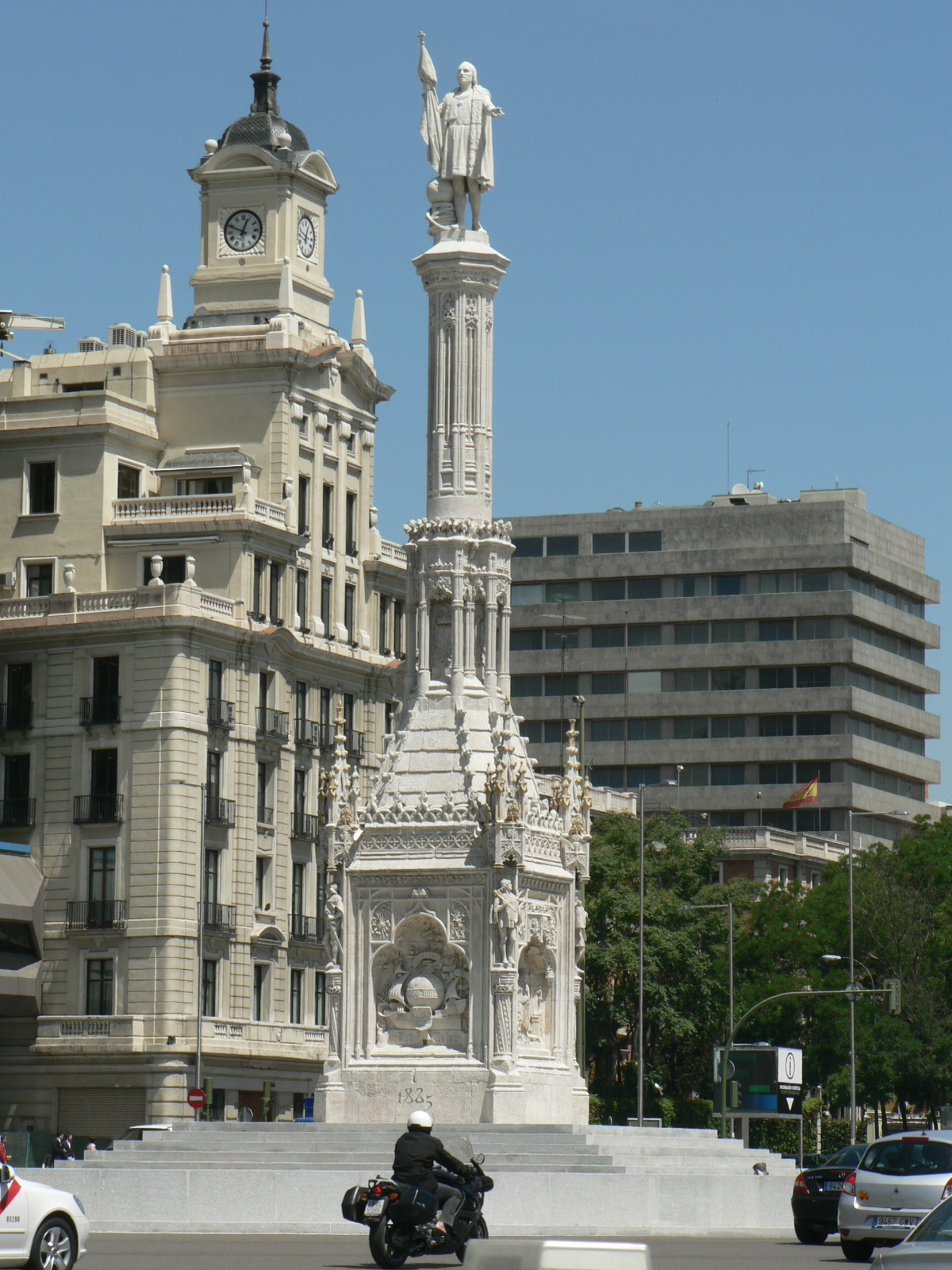
A grand square anchored by a towering Neo-Gothic monument to Christopher Columbus and one of the world's largest Spanish flags flying overhead.