
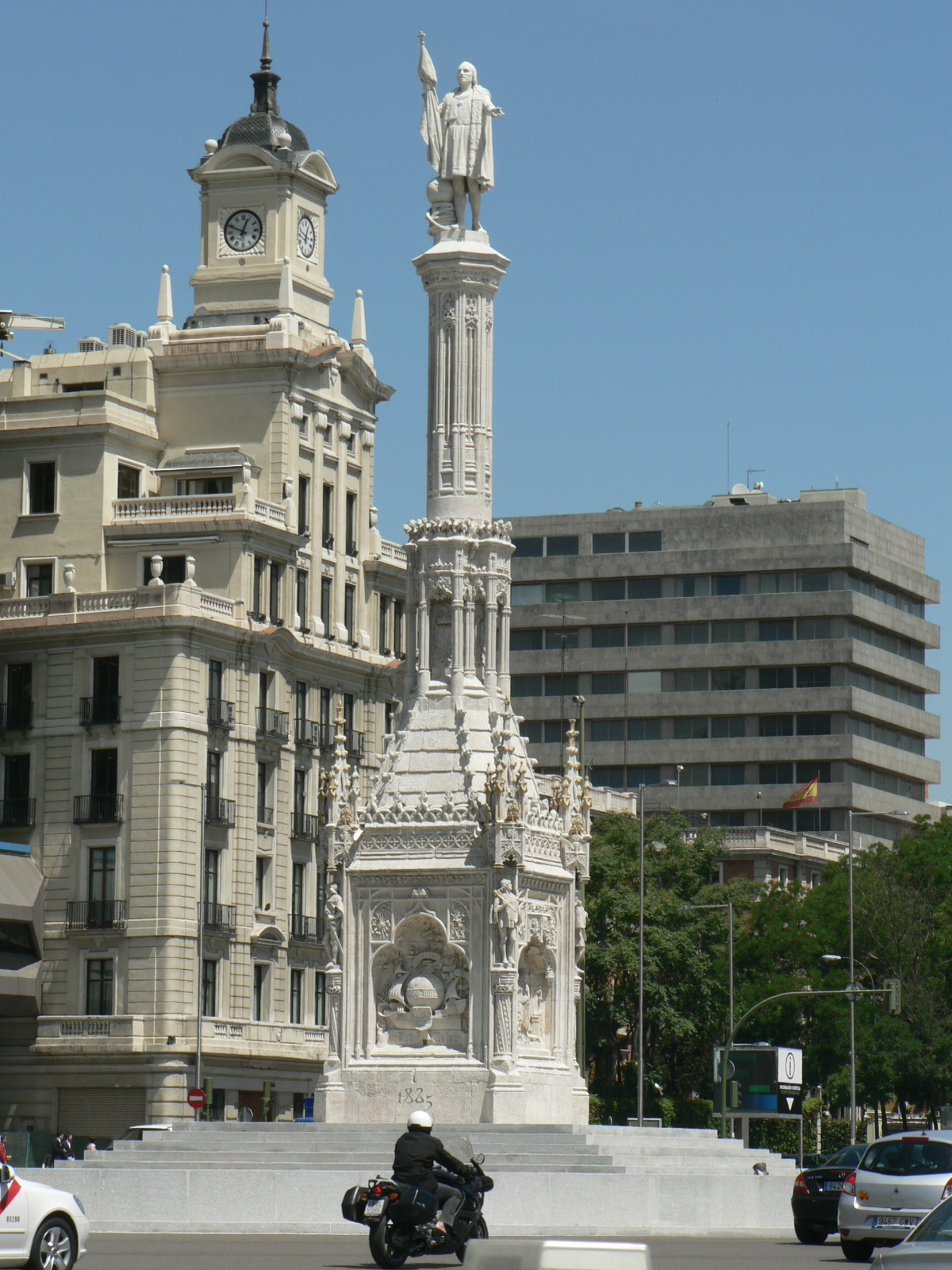
A grand square anchored by a towering Neo-Gothic monument to Christopher Columbus and one of the world's largest Spanish flags flying overhead.
The flag you can see from several streets away
Plaza de Colón announces itself before you reach it. A Spanish flag measuring 14 by 21 metres and weighing roughly 35 kilograms flies from a 50-metre pole engineered to rotate with the wind so the fabric never wraps itself around the mast. It has been up there since Spain’s National Day, 12 October, in 2001, and it is among the largest national flags flown anywhere.
That flag is the reason most people stop, and it dictates the photograph. Stand well back on the Paseo de la Castellana side to fit the pole and the monument beneath it into one frame; late afternoon suits the marble, and the flag is at its best caught mid-billow in an early-evening breeze. This is a windy junction where three of Madrid’s major avenues converge, so waiting a minute for the fabric to extend rarely takes long — and dress warmer here in winter than you would elsewhere in the centre.
A monument commissioned for a royal wedding
The 17-metre Neo-Gothic monument below the flag was built between 1881 and 1885 to a design by architect Arturo Mélida, with sculptural work led by Jerónimo Suñol. It was originally commissioned to commemorate the 1878 marriage of King Alfonso XII to María de las Mercedes de Orleans, and only afterwards rededicated to Christopher Columbus. The white marble spire carries carved reliefs referencing the voyages to the Americas, and those reliefs around the base are the part almost everyone walks past — they reward two minutes of close looking that the flag tends to steal.
The monument has not always stood where it does now. Until 2009 it sat at the edge of the adjacent Jardines del Descubrimiento, the Discovery Gardens, and was moved to its present position at the centre of the roundabout as part of a redesign of the square. The gardens remain alongside, with their own exploration-themed monuments and, usefully, the only meaningful tree cover on the site.
What is underneath the paving
The plaza has a second storey below ground. The Fernán Gómez Centro Cultural is built into the site’s underground level and runs a regular programme of exhibitions and events, often free or low-cost, and it is air-conditioned — which makes it the obvious move if you arrive in August and last four minutes on the surface. The same underground level also once housed a shuttle stop used for airport transit, a reminder that this square has always doubled as infrastructure as much as monument.
Access below is step-free with lift access, as are the surrounding pavements. Crossing between the sections of the square above, however, means using the marked pedestrian crossings.
Traffic on every side, and what that does to a visit
Be clear about what this place is: a grand civic junction, not a square you sit in. There are no terraces spilling into it, no atmosphere to soak up, and the lower paved section has almost no shade. Traffic runs on every side and the noise is constant through the day. Twenty to thirty minutes covers the monument, the flag and the reliefs properly, and that is the correct amount of time to give it. Use the crossings and pay more attention to vehicles than you would in Plaza Mayor or Puerta del Sol.
The corollary is that it is rarely crowded — most people here are passing through rather than visiting, so it never reaches the density of the central squares. Morning or early evening is more pleasant than midday, mostly because of the traffic noise and the sun.
Fitting it into the Recoletos walk
Colón works far better as a waypoint than a destination, and the walk it belongs to is the boulevard running south. The National Archaeological Museum sits directly on the square’s Serrano side, and it is a substantially better use of two hours than anything else in the immediate area. Continue down Paseo de Recoletos and you reach Puerta de Alcalá, then Plaza de Cibeles, a sequence that takes in most of Madrid’s grandest civic architecture in one continuous line. El Retiro lies just east of that stretch and is the natural green break after a run of monuments.
For food, Calle de Serrano heads into the upscale Salamanca end of things; Calle de Génova, in the other direction, has more affordable cafés a few minutes from the square.


Where to Stay Near Plaza de Colón
Real current prices via Agoda. Dates shown are indicative — pick your own on the next step.
Plaza de Colón: Quick Answers
What are the opening hours of Plaza de Colón?
Open 24 hours, always accessible
How much does it cost to visit Plaza de Colón?
Free
How do you get to Plaza de Colón?
Colón (Line 4), directly on the square; Serrano (Line 4) is also close. 20-minute walk from Puerta del Sol, or a short ride up Paseo de Recoletos
How long should you plan to spend at Plaza de Colón?
20-30 minutes
Is Plaza de Colón good for kids?
An easy, quick stop for a photo with the monument and flag, though it's mainly a traffic junction rather than a place to spend extended time
Is Plaza de Colón wheelchair accessible?
Sidewalks and the underground cultural center are step-free with elevator access; crossing between sections of the square requires using marked pedestrian crossings
Any tips for visiting on a budget?
Free to visit; the underground Fernán Gómez Centro Cultural often has free or low-cost exhibitions worth checking
Where to Go Next
 iconic
Puerta de Alcalá
A grand five-arched neoclassical gate from 1778, once the ceremonial entrance to Madrid, standing free-standing in its own plaza by Retiro Park.
 must see
El Retiro Park (Parque del Buen Retiro)
A 350-acre royal park with a rowing lake, a rose garden, and shaded avenues where Madrid comes to walk, picnic, and breathe.
 iconic
Plaza de Cibeles
An 18th-century fountain of the goddess Cybele set against the grand Cybele Palace, and the spot where Real Madrid fans have celebrated titles since the 1980s.